
Yemen: Forced Displacement Tops 338,000 as Civilian Attacks Escalate in Taiz and Lahj
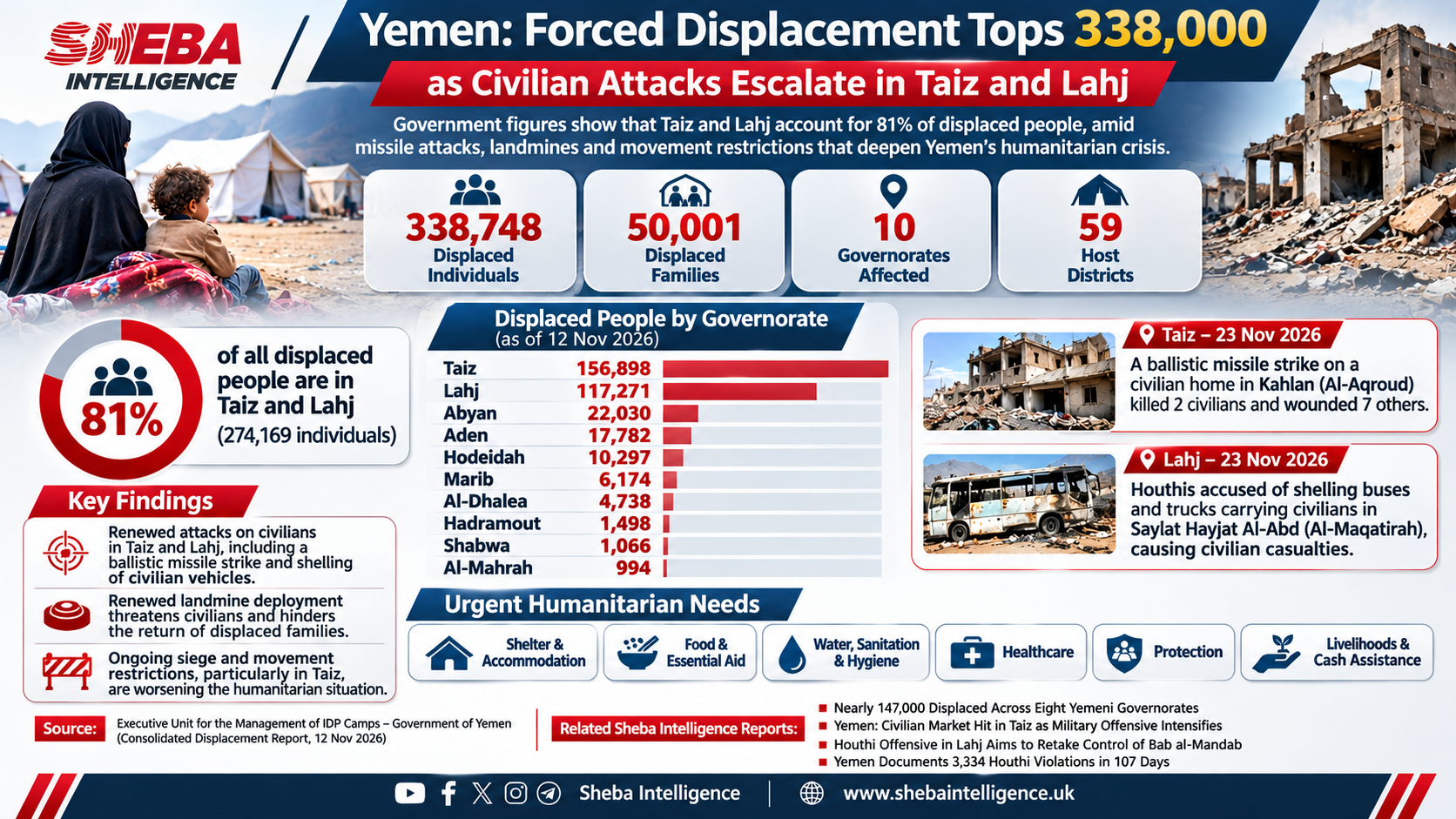
Government figures show that Taiz and Lahj account for 81% of displaced people, as missile attacks, landmines and restrictions on civilian movement deepen Yemen’s humanitarian crisis.
More than 338,000 people have been displaced across ten Yemeni governorates amid escalating fighting and reported attacks on civilians in Taiz and Lahj, according to government figures, as the ongoing military offensive and renewed landmine threats place additional pressure on vulnerable communities.
A consolidated displacement report issued by Yemen’s Executive Unit for the Management of IDP Camps (Ex.U.IDPs) recorded 338,748 displaced individuals from 50,001 families across 59 host districts in ten governorates, as of November 12, 2026.
The figures come amid continued military escalation under Operation “Dawn of Yemen,” launched on October 4, and new incidents reported by the Yemeni armed forces on November 23, including a ballistic missile strike on a civilian home in Taiz and an attack on civilian vehicles in Lahj.
Taiz and Lahj Account for 81% of Displacement
According to the government report, Taiz recorded the highest number of displaced people, with 156,898 individuals from 23,007 families, followed by Lahj with 117,271 individuals from 15,160 families.
Together, the two governorates account for 274,169 displaced people, approximately 81% of the total.
Other affected governorates include Abyan, with 22,030 displaced individuals; Aden, 17,782; Hodeidah, 10,297; Marib, 6,174; Al-Dhalea, 4,738; Hadramout, 1,498; Shabwa, 1,066; and Al-Mahrah, 994.
The figures highlight mounting pressure on host communities, particularly in areas affected by active fighting, where displaced families face urgent needs for shelter, food, clean water, healthcare and protection.
In a previous report published in September, Sheba Intelligence documented the displacement of 146,943 people across eight governorates, citing figures from the same government agency.
The latest reported total is 191,805 higher than the earlier figure. However, the geographical coverage expanded from eight to ten governorates, meaning the difference should not be interpreted solely as newly displaced individuals during that period.
Previous coverage: Nearly 147,000 Displaced Across Eight Yemeni Governorates
Taiz: Ballistic Missile Strike Kills Two Civilians
On November 23, Yemen’s armed forces accused the Houthis of launching a ballistic missile at Kahlan village in the Al-Aqroud area of Taiz governorate.
According to the military statement, the missile struck a civilian home, killing two civilians and injuring seven others.
The statement also reported that a woman was wounded by alleged Houthi sniper fire in the same area.
The incident followed another deadly attack on Al-Hadhara market in Taiz’s Al-Wazi'iyah district on November 6, which the Yemeni Ministry of Defense attributed to a Houthi ballistic missile.
Sheba Intelligence previously reported on the market attack, presenting the government’s accusations alongside a competing Houthi account blaming the Saudi-led coalition.
Independent verification of responsibility for that incident remains unavailable.
The latest reported attacks come amid continued fighting around Taiz, where prolonged restrictions on movement and access routes have compounded humanitarian suffering.
Previous coverage: Yemen: Civilian Market Hit in Taiz as Military Offensive Against Houthis Intensifies
Lahj: Civilian Buses and Trucks Targeted on Key Road
In Lahj governorate, Yemen’s Ministry of Defense accused the Houthis of shelling trucks and buses carrying civilian passengers in the Saylat Hayjat Al-Abd area of Al-Maqatirah district, along the Tur Al-Bahah road.
In a statement issued on November 23, the military spokesman said the attack caused civilian deaths and injuries but did not provide a confirmed casualty toll.
The statement stressed that the targeted vehicles were civilian and had no military function, describing the incident as a violation of international humanitarian law.
The attack highlights growing risks to civilian transportation along roads connecting Taiz and Lahj, particularly as fighting expands around key routes and population centers.
Earlier, Sheba Intelligence reported intensified Houthi military operations in Lahj’s Al-Mudaribah wa Al-Arah district, including advances toward several inland areas, government reinforcements arriving from Aden, and the establishment of a unified operations command.
These developments have heightened concerns over civilian safety and access to essential transportation routes connecting Lahj, Taiz and Yemen’s western coast.
Previous coverage: Houthi Offensive in Lahj Aims to Retake Control of Bab al-Mandab
Renewed Landmine Threats Complicate Civilian Return
The displacement crisis is unfolding alongside warnings of renewed landmine deployment in areas affected by the fighting.
The Yemen Mine Monitor recently warned of extensive landmine-laying operations attributed to the Houthis in Lahj’s Al-Mudaribah wa Al-Arah district, extending toward Kahbub, Dhubab and Bab al-Mandab.
The warnings also covered areas in Hodeidah and Taiz, including Mocha, Al-Wazi'iyah, Al-Shamaytin, Al-Ma'afer, Al-Mawasit and Jabal Habashy.
According to the monitor, renewed contamination of previously cleared areas threatens civilians, travelers, farmers and herders, while complicating the return of displaced families.
The presence of landmines and explosive remnants of war also presents long-term challenges for humanitarian access, agricultural livelihoods and reconstruction.
Previous coverage: Yemen Mine Monitor Warns of Renewed Houthi Landmine Campaign in Lahj, Taiz and Western Coast
Siege of Taiz Deepens Humanitarian Emergency
Beyond displacement and direct attacks on civilians, restrictions on movement and humanitarian access in Taiz continue to aggravate the humanitarian situation.
On November 17, Yemen’s Ministry of Human Rights reported documenting 3,334 alleged Houthi violations between August 1 and November 15, resulting in 594 civilian deaths and 1,255 injuries, according to the ministry.
The ministry warned that the continued siege of Taiz and restrictions on humanitarian access threatened approximately 2.5 million people.
It also reported that 2,450 metric tons of food assistance had been prevented from reaching intended beneficiaries, while 186 healthcare facilities had become non-operational.
These figures underscore the combined impact of direct violence, disrupted essential services and restricted access to food and healthcare.
Previous coverage: Yemen Documents 3,334 Houthi Violations in 107 Days
Urgent Appeal for Expanded Humanitarian Response
The Executive Unit for the Management of IDP Camps identified six priority areas requiring immediate humanitarian intervention: shelter and accommodation, food and essential assistance, water and sanitation, healthcare, protection, and livelihoods and cash assistance.
The government agency issued an urgent appeal for increased funding, strengthened operational capacity and expanded coordinated humanitarian assistance to address the growing needs of displaced families and host communities.
The latest developments suggest that the humanitarian consequences of Yemen’s escalating conflict extend beyond displacement from active frontlines to include attacks on civilian transportation, landmine contamination, restricted movement and deteriorating access to basic services.
International humanitarian law requires all parties to distinguish between civilians and combatants, prohibits deliberate and indiscriminate attacks against civilians, and obliges parties to take feasible precautions to minimize civilian harm.
The scale of displacement and the latest reported attacks underscore the need for independent investigations, updated casualty assessments and sustained humanitarian access to affected communities.
The displacement figures reflect government data through November 12, while the latest reported attacks are based on Yemeni Ministry of Defense statements issued on November 23. The incidents and casualty figures have not all been independently verified by Sheba Intelligence.