Yemen Security Agency Details Seiyun Raid That Killed Islamic State Spokesman
Joint forces detained another man, secured seven women and children and recovered an explosive belt and nine electronic devices
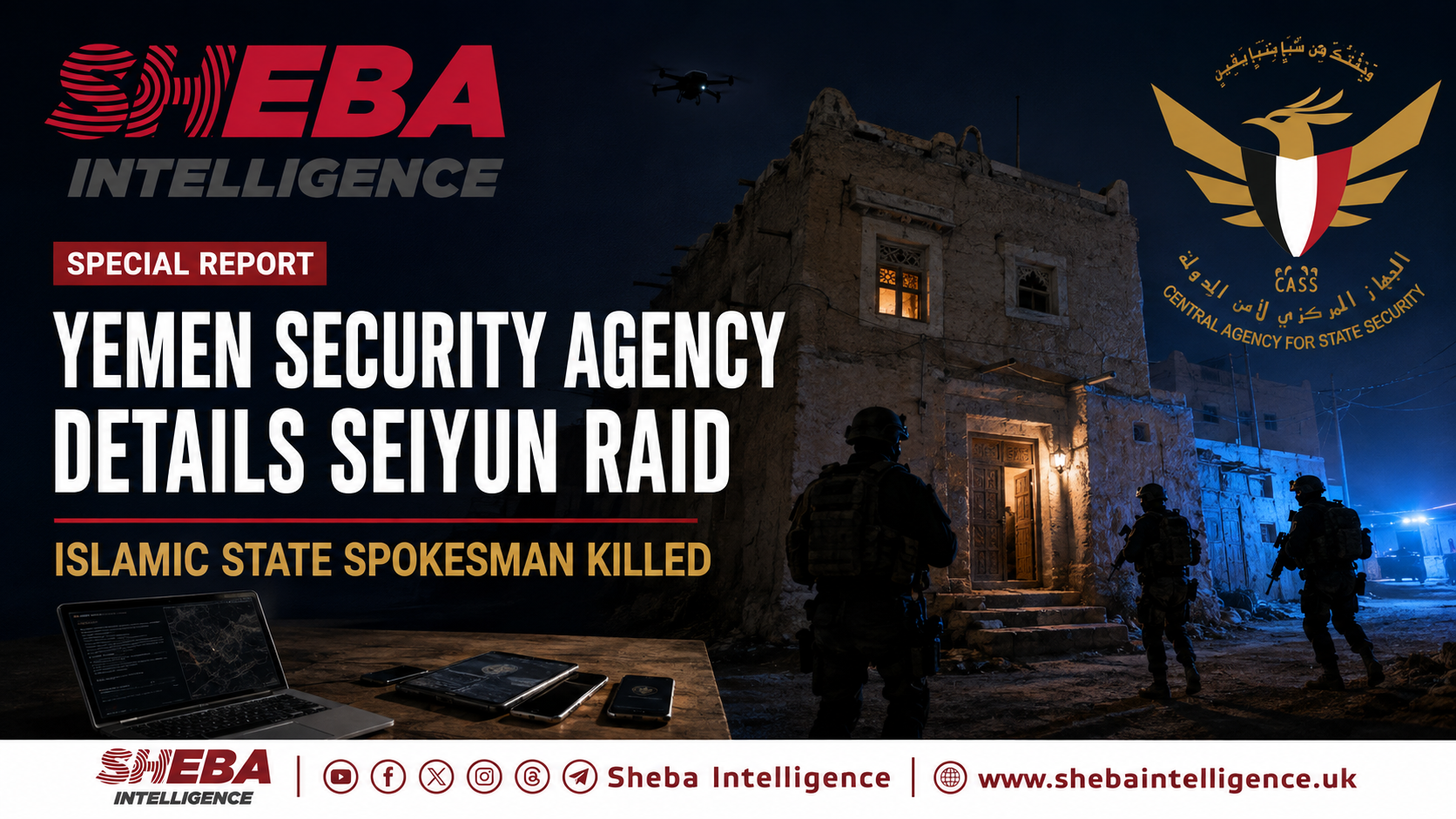
Yemen’s Central State Security Agency has released new details about the joint operation that killed Islamic State spokesman Abu Hudhayfah al-Ansari in Seiyun, Hadramawt, early on Tuesday, September 1, 2026.
In a statement issued in Aden, the agency said the raid was carried out by Coalition joint special forces and Yemen’s Counterterrorism Force 22 following intelligence cooperation with the Saudi-led Coalition to Support Legitimacy in Yemen.
Al-Ansari was hiding in a residential building with eight civilians: one man, two women and five children, according to the statement.
The agency said al-Ansari was killed after resisting the raiding force. Another person found inside the building was wounded while resisting and subsequently detained. He received medical treatment before being transferred to a secure location.
The statement did not identify the detained man or clarify the nature of his relationship with al-Ansari.
Explosive Belt and Electronic Devices Recovered
During a search of the building, the forces recovered an explosive belt, which was defused and later destroyed in a controlled detonation to eliminate the danger it posed to civilians.
They also seized two laptops, five mobile phones and two tablets. The devices were secured for examination, documentation and further investigation by the relevant authorities.
The electronic devices could prove to be the operation’s most significant intelligence gain if they contain information about Islamic State personnel, support networks or communications between the group’s central leadership and its branch in Yemen.
The agency said the two women and five children were removed from the building and transferred to a safe location without injury. No civilians were harmed and no collateral damage was reported in the densely populated residential neighbourhood.
The joint special forces withdrew from the area after completing the operation.
Intelligence Surveillance Preceded the Raid
The agency attributed the operation’s success to intelligence-sharing, surveillance and reconnaissance systems, as well as joint operational planning and training.
It said the Yemeni government would continue pursuing wanted militants and coordinating with the Coalition and international partners to prevent the country from becoming a safe haven for terrorist groups.
The detailed statement also clarifies conflicting preliminary accounts of the raid. Initial information cited by local journalist Fathi bin Lazraq suggested that al-Ansari had been wounded and captured before dying, while another man with him had been killed.
According to the security agency’s subsequent account, however, al-Ansari was killed after resisting the force, while the other man was wounded, detained and given medical treatment.
Islamic State Spokesman and Yemen Branch Leader
As Sheba Intelligence previously reported, militant-groups specialist Mohammed bin Faisal identified Abu Hudhayfah al-Ansari as Yemeni national Mithaq Thabit Haitham al-Radfani.
According to Faisal, al-Radfani served as Islamic State’s official spokesman while simultaneously leading the group’s self-proclaimed “Yemen Province.” He was also considered one of the group’s most prominent religious officials, combining ideological authority with leadership of its Yemeni branch and a role in its central media apparatus.
Al-Ansari first emerged publicly as Islamic State’s spokesman in August 2023, when he announced the death of the group’s leader, Abu al-Hussein al-Husseini al-Qurashi, and the appointment of Abu Hafs al-Hashimi al-Qurashi as his successor.
He subsequently issued central audio messages communicating the organisation’s positions and delivering instructions to its branches and supporters.
Faisal had said that al-Radfani routinely carried an explosive belt, making his capture alive extremely difficult. The security agency’s confirmation that an explosive belt was found inside the building is consistent with that account, although the statement did not say whether al-Ansari was wearing it when the raid began.
Al-Radfani’s death therefore represents more than the removal of a local commander. His reported positions indicate that Yemen was sheltering a figure connected to Islamic State’s central leadership and media operations.
The wider effect of the operation will depend on what investigators recover from the seized devices and whether the data exposes additional cells, support networks or communication channels linking Islamic State’s central leadership to its branch in Yemen.