Yemeni Army Captures Senior Houthi Security Officials in Taiz as Drone Strikes Deplete Field Commanders
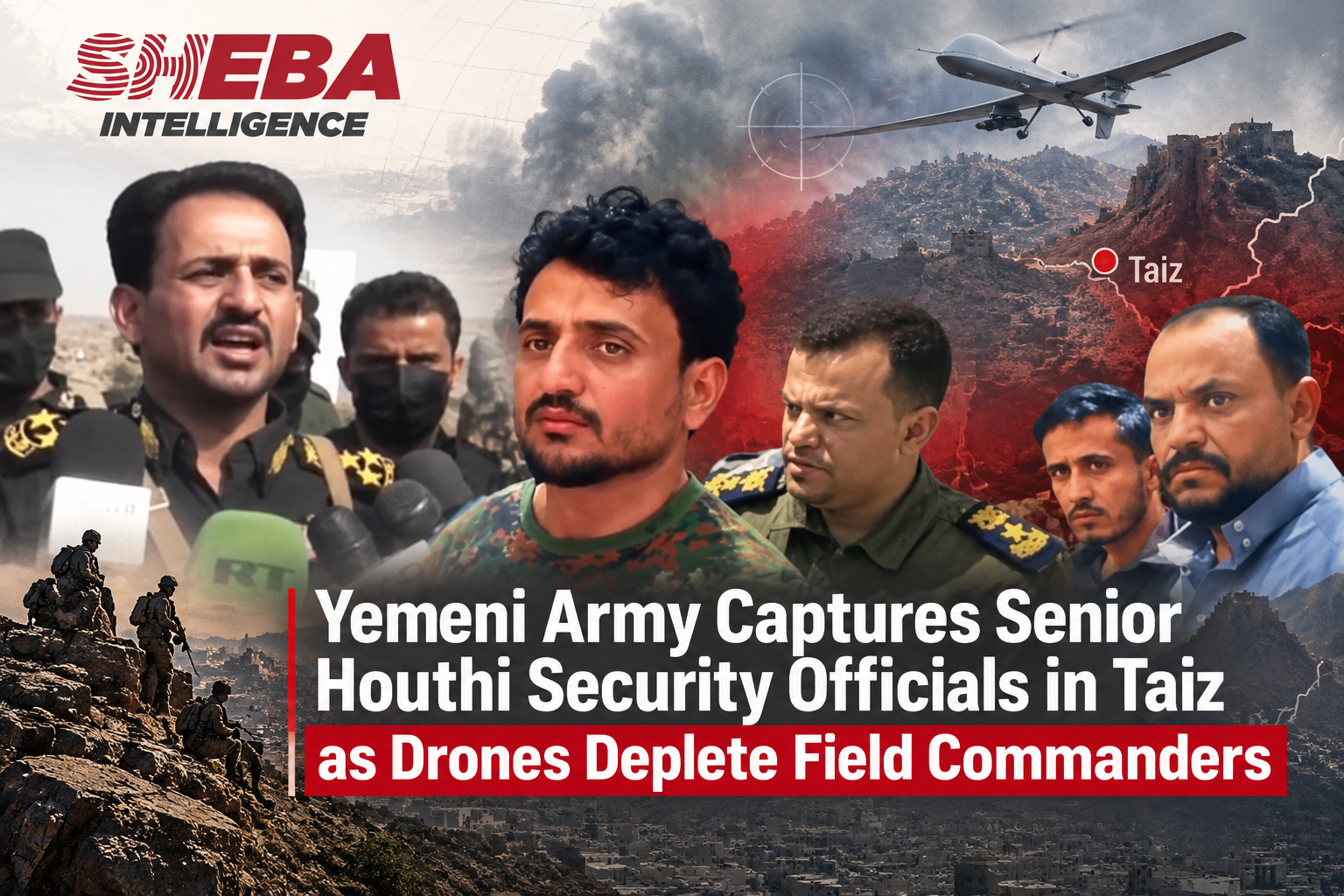
Security expert tells Sheba Intelligence that the Houthis are deploying internal security officials to reinforce the Taiz front as government drones increasingly threaten commanders behind the front lines.
Yemeni government forces have captured senior Houthi security and intelligence officials during fighting on the western front of Taiz, exposing growing pressure on the group's field command structure as government drone operations expand beyond frontline positions.
The Fifth Presidential Guard Brigade released footage showing five captured Houthi personnel, including Akram Amer al-Mutawakkil, director-general of the Anti-Narcotics Department in the Houthi-controlled Interior Ministry, and Mohammed Saeed Mahyoub al-Junaid, a senior official in the group's Preventive Security apparatus in Taiz province.
According to the Yemeni army, the five were captured during military operations on the western Taiz front, where government forces are engaged in an offensive against Houthi positions under Operation Dawn of Yemen.
The capture comes amid intensified fighting around Taiz, a strategically important city where the Houthis have deployed additional forces in an effort to challenge government positions.
Houthis Acknowledge Capture but Dispute Military Roles
Abdulqader al-Murtada, the Houthi official responsible for prisoner affairs, acknowledged that the five men had been captured but denied that they were military commanders.
He claimed they were Interior Ministry personnel assigned to organize and secure Taiz Central Prison and had mistakenly entered government-controlled territory because of overlapping front lines.
His account differs from the Yemeni army's description of the captives as senior Houthi figures involved in the military confrontation.
Sheba Intelligence could not independently verify the circumstances of their capture or the specific mission they were carrying out.
Security Analysis: Drone Warfare Expands Attrition to Field Commanders
A security expert told Sheba Intelligence that the capture of senior Houthi security and intelligence personnel reinforces earlier reports that the group has mobilized substantial military and internal security resources in an effort to seize Taiz.
According to the expert, the Houthis have deployed personnel from security institutions normally responsible for maintaining internal control in areas under their authority, including police station chiefs from Sana'a, to reinforce their forces on the Taiz front.
The expert said this mobilization reflects the importance the Houthis attach to the battle for Taiz but also reveals increasing pressure on their field command structure.
Although the group retains the ability to recruit and mobilize fighters rapidly, particularly from rural districts under its control in Taiz province, replacing experienced battlefield commanders has become a growing challenge.
The expert attributed this development largely to the expanding use of unmanned aerial vehicles by Yemeni government forces, which have extended the reach of strikes into areas behind Houthi front lines.
Previously, battlefield attrition was concentrated mainly among fighters deployed in assault formations, while commanders remained in relatively protected positions behind the fighting.
The growing deployment of drones has changed that pattern, exposing field commanders and operational personnel to strikes in locations previously considered safer.
As a result, the Houthis face mounting pressure not only on their frontline manpower but also on the experienced personnel responsible for directing operations, coordinating military units and managing battlefield movements.
Unprecedented Pressure Since 2014
Based on his daily monitoring of Yemen's battlefronts, the security expert told Sheba Intelligence that the Houthis are experiencing what he considers an unprecedented level of attrition among their field commanders since the group seized Sana'a in 2014.
He explained that previous phases of the conflict largely allowed the group to preserve its field leadership while absorbing losses among frontline fighters. The growing effectiveness and reach of drone operations have increasingly undermined that distinction.
This assessment has not been independently established through comparative data on command-level casualties throughout the conflict.
The expert said the deployment of internal security officials to combat fronts may indicate that the Houthis are struggling to replace experienced military leaders at the same pace as they recruit new fighters.
The capture of senior security personnel in Taiz therefore highlights a broader challenge facing the group: maintaining an effective field command structure while continuing to mobilize manpower for sustained military operations.
The emerging distinction is between the Houthis' ability to recruit fighters and their capacity to replace experienced commanders. As drone strikes increasingly reach command positions behind the front lines, the loss of field leadership could become a more consequential form of battlefield attrition than manpower losses alone.