
Yemen’s History for Sale: The Hidden Journey of Antiquities from Looting to International Markets
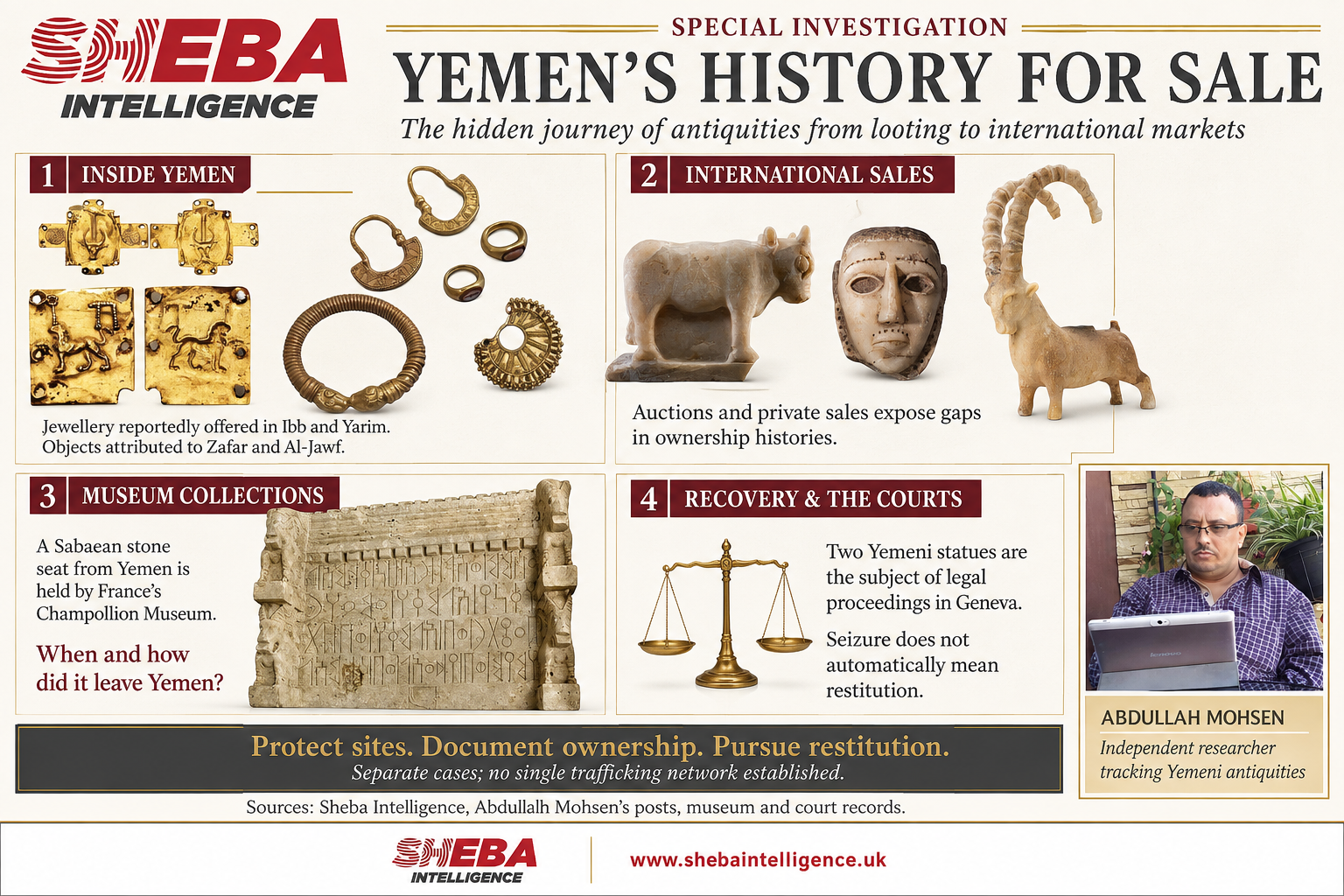
Jewellery and a dagger reportedly offered inside Yemen, a throne in a French museum and two statues before Swiss courts reveal a trade that extends beyond auction catalogues.
Before Yemeni antiquities appear behind museum glass or on international auction platforms, photographs circulate of objects reportedly being offered for sale inside the country. Between those two stages, essential details often remain missing: who excavated the object, who first bought it, how it crossed the border and what documentation accompanied its entry into a private collection abroad.
Sheba Intelligence traced published information and images concerning gold jewellery attributed to Zafar and Al-Jawf and a dagger handle reportedly offered in Yarim. The investigation also examined a Sabaean throne in France’s Champollion Museum, two statues involved in legal proceedings in Geneva and an ancient portrait head reported to have entered the private-sales market.
The research drew on posts by Abdullah Mohsen, an independent researcher who tracks Yemeni antiquities and received the General Union of Arab Archaeologists’ 2025 award for protecting archaeological sites and buildings from risks and armed conflict. It also included a review of museum records, court documents and academic sources.
These cases do not establish that a single network controls the objects concerned. They do, however, expose different stages in the loss of Yemen’s heritage: objects reportedly circulating locally, others offered outside public auctions, and pieces whose recovery now depends on ownership records and legal proceedings abroad.
Objects That Could Still Be Protected
The photographs show gold plaques, earrings, rings and bracelets attributed in the published accounts to Zafar and Al-Jawf and reportedly offered in Ibb governorate. Other information describes jewellery and bronze objects for sale in Yarim, including a decorated dagger or sword handle and a twisted bracelet.
In his account of the collection, Mohsen accuses a network involved in looting sites in Ibb and Dhamar of benefiting from protection or acquiescence by influential local figures. He says photographs of the handle and bracelet came from a source who requested anonymity.
The significance of these reports is that they concern objects believed to remain inside Yemen, rather than antiquities discovered only after they have reached foreign markets. If the information is substantiated, identifying their holders and storage locations could provide an opportunity to prevent their export and recover evidence about the circumstances of their excavation.
The photographs record the objects’ appearance and decoration. They do not, by themselves, establish where the pieces were excavated, when the images were taken or who is responsible for trading them. Those questions require investigation on the ground.
More Than the Value of Gold
The collection’s importance extends well beyond its metal value. In a specialist assessment published on the researcher’s page, Dr Leila Aquil, an archaeologist specialising in ancient Yemeni jewellery, connects the handle’s decoration and craftsmanship to known examples from ancient Yemen. She identifies fine wirework, knot motifs and recessed square settings that may once have held decorative materials, comparing the handle with two published examples, including one from Al-Usaybiyah.
Her assessment of the jewellery identifies local characteristics in the granulation, wirework and ornamentation of some earrings. She also refers to the protective formula “Wadd Ab” and compares the plaques and earrings with examples held in the museums of Aden and Sana’a and others excavated at Yemeni sites.
Such features can illuminate craftsmanship, taste, beliefs and cultural exchange. Removing an object from its original setting, however, separates it from other evidence: the tomb or building that contained it, the objects found alongside it and the archaeological layer that could help establish its date.
The published illustration of the dagger handle includes one image labelled as original and another as processed. Details made clearer in the processed version cannot therefore be treated as independent evidence of the object’s condition or as a substitute for direct examination.
In a published comment on the collection, history professor Aref Ahmed Al-Mikhlafi called for an official investigation into the looting. He warned against treating antiquities as an issue that could be deferred, stressing that they are irreplaceable historical evidence.
A Throne in France—and an Unanswered Question of Provenance
At the Champollion Museum in Figeac, France, a limestone object is officially catalogued as a South Arabian seat from Yemen, dated to the seventh century BC and registered under inventory number 05.08.1. Its inscriptions include the names of deities and a reference to a Sabaean ruler.
A published account by Mohsen links the object to Wadi Raghwan in Marib and to a throne discussed in François Bron’s 2013 study of six inscriptions. The study’s academic abstract describes the inscriptions as originating from the looting of archaeological sites in Yemen. That reference warrants scrutiny of the proposed identification and the object’s ownership history, but does not alone establish when it left Yemen or the responsibility of its current holder.
The question is not simply whether the throne is authentic. It is what documentation connects its original location to its present custody: when was it acquired, from whom, what is known about its earlier ownership and does an official export document exist?
French law may offer a route to examination and restitution if its conditions are met. Article L124-1 of the Heritage Code, in force in its amended form since May 2026, allows a public body to seek the annulment of its acquisition of a cultural object when evidence establishes that it was stolen or unlawfully exported after April 23, 1972. Applying that provision to the throne would require proof of the relevant facts and dates—not merely its presence in a French museum.
In Geneva, Seizure Does Not End the Case
The case of two statues registered as ST.FIG.047 and ST.FIG.048 demonstrates that locating and securing an antiquity does not automatically lead to its recovery.
A June 20, 2025 ruling by Geneva’s Criminal Appeals Chamber recounts an attempt to remove the female statue from the customs-controlled zone in 2022 to show it to a prospective buyer. A subsequent expert assessment raised concerns about its provenance.
The chamber overturned an earlier decision closing the case and lifting the seizure, returning it for further proceedings. The published record notes a Federal Supreme Court appeal filed in July 2025. This review found no subsequent published decision conclusively determining the objects’ fate.
Mohsen’s review highlights the absence of visible Yemeni legal representation or expert submissions in the judgments he examined. That observation warrants an official explanation but does not exclude unpublished action.
The case underscores the importance of both specialist evidence and sustained legal engagement: securing a disputed object provides temporary protection, but does not replace a documented claim to its return.
A Market Beyond Auction Catalogues
The trade in antiquities is not confined to public bidding. Private sales allow objects to change hands outside the auction room, sometimes with fewer details available to the public.
One case discussed in the posts concerns an alabaster portrait head reportedly offered through Christie’s private-sales department after an earlier appearance at Sotheby’s. According to the provenance information reproduced in the account, the piece belonged to the Antonin and Christiane Besse collection, was acquired in Yemen during the 1960s and was registered for export in Aden in 1967.
This differs from an object with no declared acquisition history. It provides specific information whose supporting documents should be examined; its presence abroad is not, by itself, evidence of an unlawful transaction.
The case nevertheless illustrates the limits of monitoring public auctions alone. Christie’s openly offers a service for buying and selling outside the auction room. Private sales are not evidence of trafficking, but they can make changes in ownership harder for outside researchers to trace.
Likewise, labels such as “South Arabian” or “Western Asiatic” do not answer questions about an object’s precise origin. “South Arabian” is also an established academic term and does not, by itself, demonstrate an attempt to conceal Yemeni identity. A broad classification, however, is no substitute for identifying the original site and export history when that information is known.
From Al-Jawf to Foreign Markets: The Domestic Context
In July 2026, Sheba Intelligence reported information from a tribal source in Al-Jawf concerning around 80 antiquities, including inscriptions and bronze statues, suspected of being prepared for smuggling through areas near the Yemeni-Saudi border.
The source said a network used African migrants to transport and conceal objects and alleged that some of those involved had links to leaders of armed groups, including the Houthis. These claims remain attributed to the source, and there is no evidence connecting those objects to the other cases examined in this investigation.
The reports nevertheless point to a common priority: tackling the trade before objects cross the border, through investigations into possession, storage and local sales—not only when new photographs appear in a foreign auction catalogue.
Recovery Is Possible, but It Requires Evidence
American restitution cases demonstrate that the passage of decades does not necessarily close a claim. In April 2023, Manhattan authorities announced the return of three antiquities to the Yemeni people. They included an alabaster ram that authorities said had been looted from the Hayd bin Aqeel necropolis in Shabwa during the 1994 civil war, sold in London and eventually seized in New York in 2023.
The objects were to remain temporarily at the Smithsonian until they could safely be physically returned to Yemen. The case distinguishes restitution of ownership from repatriation to the country itself. It also shows that a long history in a private collection does not erase an act of looting when evidence can establish it.
The available information and images place two parallel tasks before Yemeni authorities: investigating objects reportedly circulating inside the country that could still be prevented from leaving, and pursuing pieces abroad through specific claims supported by records and legal expertise.
The photographs matter because they may preserve identifying features that allow objects to be recognised if they later reappear under different descriptions or ownership histories. But photographic records should not become the last substitute for protection. Every object saved from looting retains something that auctions cannot price and courts cannot restore once it has been lost: its place in Yemen’s history.