Direct Iranian Flight to Sana’a Highlights Iran–Houthi Air Coordination During Khamenei Funeral Arrangements
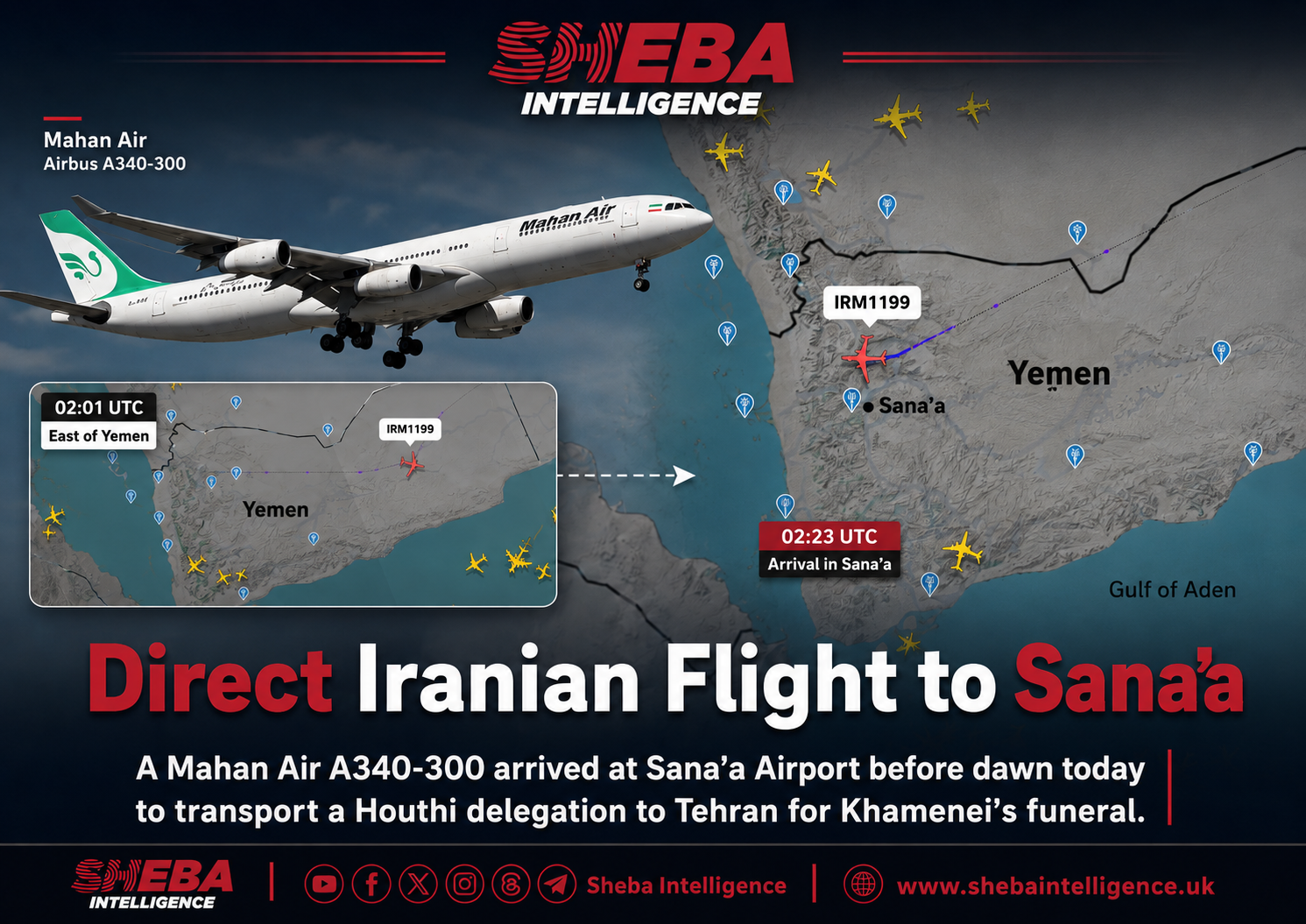
Flight-tracking screenshots reviewed by Sheba Intelligence show Mahan Air flight IRM1199/W51199, operated by an Airbus A340-300, approaching Sana’a before dawn Friday to transport a Houthi delegation to Tehran.
A Mahan Air aircraft arrived at Sana’a International Airport before dawn on Friday in a politically sensitive flight from Tehran, reportedly to transport a Houthi delegation to Iran for the funeral ceremonies of late Supreme Leader Ali Khamenei.
Flight-tracking screenshots reviewed by Sheba Intelligence show the aircraft operating under flight code IRM1199 / W51199. The screenshots identify the aircraft type as Airbus A340-300 — A343, and place it over Yemeni airspace between around 02:01 and 02:23 UTC, equivalent to 05:01–05:23 Sana’a time, as it approached the capital from the east before landing.
According to information obtained by Sheba Intelligence, the aircraft had been expected to arrive the previous day, but the flight was postponed. The Houthi delegation reportedly returned from the airport after the delay, before coming back following renewed arrangements for the Iranian aircraft’s arrival. The same aircraft is expected to return the delegation after the funeral ceremonies conclude.
From a technical perspective, the Tehran–Sana’a sector is well within the operational capability of the Airbus A340-300, a long-range, four-engine wide-body aircraft. The direct air distance between Tehran and Sana’a is roughly 2,300–2,400 km. At typical cruise speed, a direct or near-direct flight would likely take around 2 hours and 45 minutes to just over 3 hours, excluding climb, descent, airspace restrictions and possible holding.
If the aircraft used a wider route through or near Omani airspace, the distance could extend toward approximately 3,100–3,200 km, making a flight time of around 3 hours and 45 minutes to more than 4 hours technically plausible. The possible use of an Oman-linked corridor remains unconfirmed, but it would be consistent with a lower-friction route designed to avoid more sensitive Gulf or Red Sea airspace.
The timing of the flight is significant. Iran is holding funeral events for Khamenei months after his death in U.S.-Israeli strikes on February 28, 2026. The state funeral is expected to begin in Tehran on July 4 and conclude with burial in Mashhad on July 9, with ceremonies also linked to religious cities including Qom, Najaf and Karbala.
The funeral has become a major political and religious event for Tehran, intended to project continuity and cohesion after months of conflict. Iran has also warned the United States and Israel against attacks during the funeral processions, while international delegations and Iran-aligned regional actors are expected to attend.
The flight carries added sensitivity because of Mahan Air’s sanctions profile. The U.S. Treasury designated Mahan Air in 2011, accusing the airline of providing financial, material and technological support to the IRGC-Qods Force, including transportation services.
For the Houthis, the arrival of an Iranian aircraft directly at Sana’a airport underlines the continued political and logistical channel with Tehran. For regional observers, the flight raises questions about the understandings that allowed the aircraft to reach Sana’a, the air corridor used, and whether the trip was coordinated through temporary regional arrangements linked to Khamenei’s funeral.