Houthi FPV Drones: A New Tactical Threat on Yemen’s Frontlines
A new class of combat drone has appeared in the Houthi arsenal, adding a tactical capability that could reshape fighting along Yemen’s active frontlines.
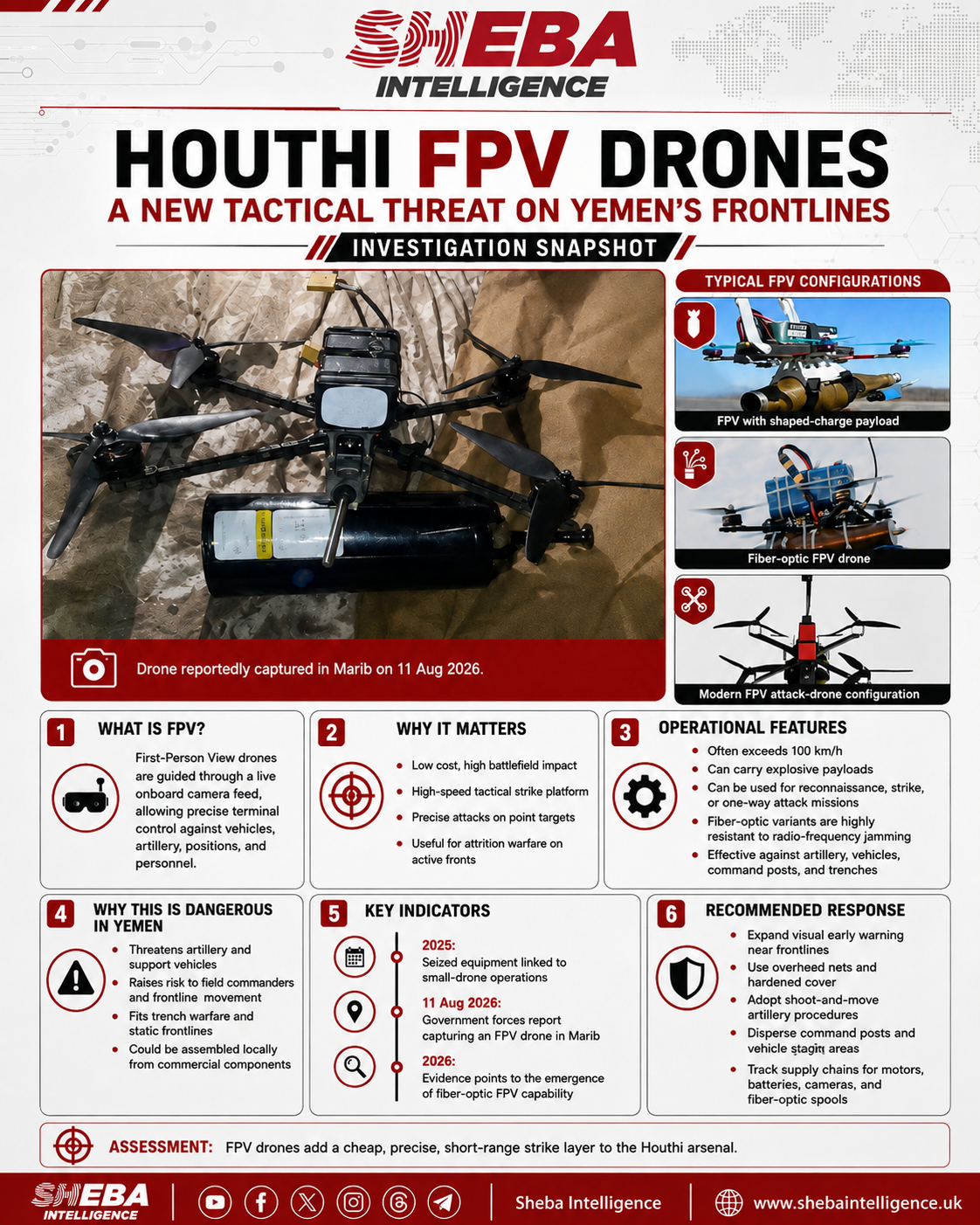
On August 11, 2026, Yemeni government forces in Marib recovered an FPV drone reportedly operated by the Houthis. Images circulated afterward show a small quadcopter configured for attack missions. Available evidence also indicates the use of a fiber-optic control system, a technology developed to maintain reliable command and video transmission in environments saturated with electronic warfare.
The significance of the drone goes beyond the capture of a single aircraft. It suggests that the Houthis are adapting lessons from recent wars and expanding their drone capabilities from long-range strategic strikes toward inexpensive precision weapons designed for direct battlefield use.
A Different Type of Drone Warfare
FPV stands for First-Person View. The operator flies the drone through a live video feed transmitted from a forward-facing camera, allowing precise control until the final seconds of an attack.
Unlike larger Houthi drones designed to strike infrastructure or distant targets, FPV systems are primarily tactical weapons. They are used against vehicles, artillery positions, fortified posts, command points and personnel close to the frontline.
Their main advantage is the combination of low cost, speed and accuracy.
A small FPV drone can carry an explosive charge and be manually guided toward a vulnerable point on a vehicle, an artillery piece or an exposed position. Its cost is only a fraction of the value of many targets it can potentially destroy.
This cost imbalance has made FPV drones one of the most influential battlefield weapons to emerge from the war in Ukraine.
Fiber-Optic FPV Drones
The drone recovered in Marib is especially significant because of indications that it uses fiber-optic communication.
Conventional FPV drones transmit control commands and video through radio frequencies. These signals can be disrupted by electronic warfare systems.
Fiber-optic versions use a thin cable connected to the drone that unwinds during flight. Command signals and live video travel through the cable rather than through a wireless link.
This removes one of the main vulnerabilities of ordinary FPV drones.
Radio-frequency jammers cannot easily disrupt the command link, and the aircraft does not require GPS navigation to reach its target. The operator retains direct visual control until impact as long as the fiber connection remains intact.
Fiber-optic drones still have limitations. Their cables can become entangled with vegetation, structures or terrain. They can also be destroyed by direct fire, physical barriers and specialized counter-drone systems.
The technology nevertheless provides a major advantage in areas where electronic jamming has become the primary defense against small drones.
Why the Technology Matters in Yemen
Yemen’s frontlines provide an environment well suited to FPV operations.
Marib, Taiz, Al-Dhalea and the western coast contain static defensive positions, artillery batteries, armored vehicles, observation posts and command sites located relatively close to opposing forces.
Small FPV drones can exploit these conditions.
They can fly at low altitude, approach through terrain that limits detection and strike individual targets with precision. Operators can adjust course during the final approach and pursue moving vehicles or personnel.
This creates a different threat from conventional missiles or long-range drones.
The target is no longer necessarily a major military base or strategic installation. A single artillery gun, armored vehicle, communications post or field commander can become a viable target.
A Threat to Government Artillery:
The timing of the FPV appearance is important.
Government forces have recently expanded their own use of tactical drones for reconnaissance and artillery correction. Video from several fronts has shown drones identifying Houthi movements and helping direct artillery fire against positions and concentrations of fighters.
FPV drones could provide the Houthis with a relatively inexpensive method of attacking those artillery systems.
Once an artillery position is detected, an FPV drone can target the gun, its ammunition vehicle, crew or supporting equipment without requiring a ballistic missile or a larger strike drone.
This could force government forces to change how artillery units operate.
Guns would need to relocate more frequently, ammunition would have to be dispersed, camouflage improved and firing positions abandoned quickly after engagement.
The same threat applies to air-defense teams, communications vehicles and electronic-warfare equipment.
Vehicles and Field Commanders
FPV drones also increase the vulnerability of battlefield movement.
Military vehicles traveling near frontlines can be tracked and attacked during movement. The operator can continue adjusting the drone’s direction until impact.
Armored vehicles are particularly vulnerable when a drone is guided toward weak points such as exposed sensors, engine compartments or openings.
Field commanders also face greater risk.
Small command posts, vehicles used by officers and temporary meeting locations can all be targeted once detected.
The technology could also be used for targeted attacks against specific individuals. There is currently insufficient evidence to conclude that the Houthis have established FPV cells inside government-controlled cities for assassination operations. The greater immediate threat remains their use along active military fronts.
Earlier Signs of Houthi Interest
The appearance of an FPV drone in August 2026 follows earlier indications that the Houthis were seeking components associated with tactical drone systems.
In 2025, National Resistance forces displayed equipment seized from shipments allegedly bound for Houthi-controlled territory. The items included DJI Mavic 3 drones, Taranis X9D control systems and other electronic equipment used in small unmanned aircraft operations.
The distinction is important.
The DJI Mavic 3 is not a combat FPV drone. It is primarily a commercial surveillance and photography platform that has also been widely adapted for military reconnaissance.
The presence of these systems nevertheless showed growing Houthi interest in small tactical drones and commercially available control technology.
The aircraft recovered in Marib represents a more significant development because its configuration appears designed for direct attack.
The Iranian Connection
Iran has closely followed the evolution of FPV warfare and has increasingly incorporated inexpensive tactical drones into its military ecosystem.
The expansion reflects lessons learned from Ukraine, where small drones evolved from improvised battlefield tools into organized weapons operating alongside artillery, reconnaissance units and electronic warfare.
Iranian-backed armed groups have also demonstrated growing interest in this technology.
The appearance of similar capabilities among the Houthis therefore fits a broader pattern of technological exchange inside Iran’s regional network.
The available images do not establish where the Marib drone was manufactured.
FPV systems are assembled from widely available commercial components. Motors, batteries, cameras, flight-control boards and frames can be sourced individually and assembled locally.
A drone recovered in Yemen therefore does not need to have been manufactured in Iran to reflect Iranian technical assistance.
Training, design knowledge, components and operational experience can be transferred without shipping complete aircraft.
Local Assembly Is the Greater Risk
The most serious scenario is not the smuggling of finished FPV drones into Yemen.
It is the establishment of a local assembly capability.
FPV drones do not require the industrial infrastructure needed to manufacture ballistic missiles or larger unmanned aircraft. Small workshops can assemble them using imported commercial components.
A decentralized production network would be difficult to detect and disrupt.
Frames, motors, electronic speed controllers, cameras, antennas and batteries can be imported separately under civilian descriptions. Explosive payloads can then be integrated locally.
Fiber-optic systems add another component to the supply chain but do not fundamentally change the manufacturing model.
If the Houthis establish reliable local assembly, the number of drones available to frontline units could increase rapidly.
At that point, the threat would shift from isolated attacks to sustained attrition.
Numbers Will Determine Their Impact
One recovered drone does not alter the military balance.
FPV effectiveness depends on scale.
Operators require training. Reconnaissance teams must locate targets. Communications between surveillance units and drone operators must be fast. Batteries, replacement parts and explosive payloads must reach frontline units continuously.
A few FPV drones provide a limited capability.
Hundreds of drones operating across several fronts would create a different battlefield.
The key indicator will therefore be the frequency of future attacks.
Repeated FPV strikes recorded across Marib, Taiz, Al-Dhalea or the western coast would demonstrate that the Houthis have moved beyond experimentation and established an operational system.
What Government Forces Need to Change
The appearance of fiber-optic FPV drones requires a defensive response that goes beyond electronic jamming.
Government forces should treat small-drone defense as a permanent component of frontline operations rather than an additional air-defense mission.
Priority should be given to early visual detection around artillery positions, command posts and vehicle assembly areas. Observation teams need to be trained to identify low-flying drones before they enter their final attack run.
Physical protection will become increasingly important. Overhead nets, reinforced shelters, covered vehicle positions and barriers around artillery and command posts can reduce the effectiveness of FPV attacks, including fiber-optic variants.
Artillery units should adopt strict shoot-and-move procedures. Remaining in the same firing position after engagement increases the likelihood of detection and attack.
Vehicles and personnel should avoid predictable movement patterns close to the frontline. Command posts should be dispersed, temporary and concealed.
Electronic warfare remains necessary against conventional radio-controlled FPV drones, but forces should not assume that jamming alone provides protection. Fiber-optic systems require a combination of detection, physical defenses, direct-fire counter-drone weapons and rapid movement.
Intelligence collection should also focus on the supply chain.
Motors, flight controllers, cameras, high-discharge batteries, fiber-optic spools and specialized electronic components can provide early warning of attempts to establish large-scale FPV production.
Training is equally critical.
Infantry and vehicle crews need procedures for responding to an approaching drone. Counter-FPV drills should become part of routine frontline preparation in the same way that units prepare for artillery and missile attacks.
A New Layer in the Houthi Arsenal
For years, the Houthis developed missiles and long-range drones capable of threatening cities, energy infrastructure and maritime traffic.
FPV technology adds another layer.
It gives them a weapon designed for the opposite end of the battlefield: short-range, inexpensive and precise enough to attack a single vehicle, gun position or group of soldiers.
The captured drone in Marib should therefore be viewed as an early warning rather than an isolated incident.
The most important question is no longer whether the Houthis possess FPV technology.
It is whether they can manufacture or assemble it in sufficient numbers, train operators and integrate the drones into reconnaissance and frontline units.
If that happens, FPV drones could become one of the principal weapons of attrition in the next phase of Yemen’s war.