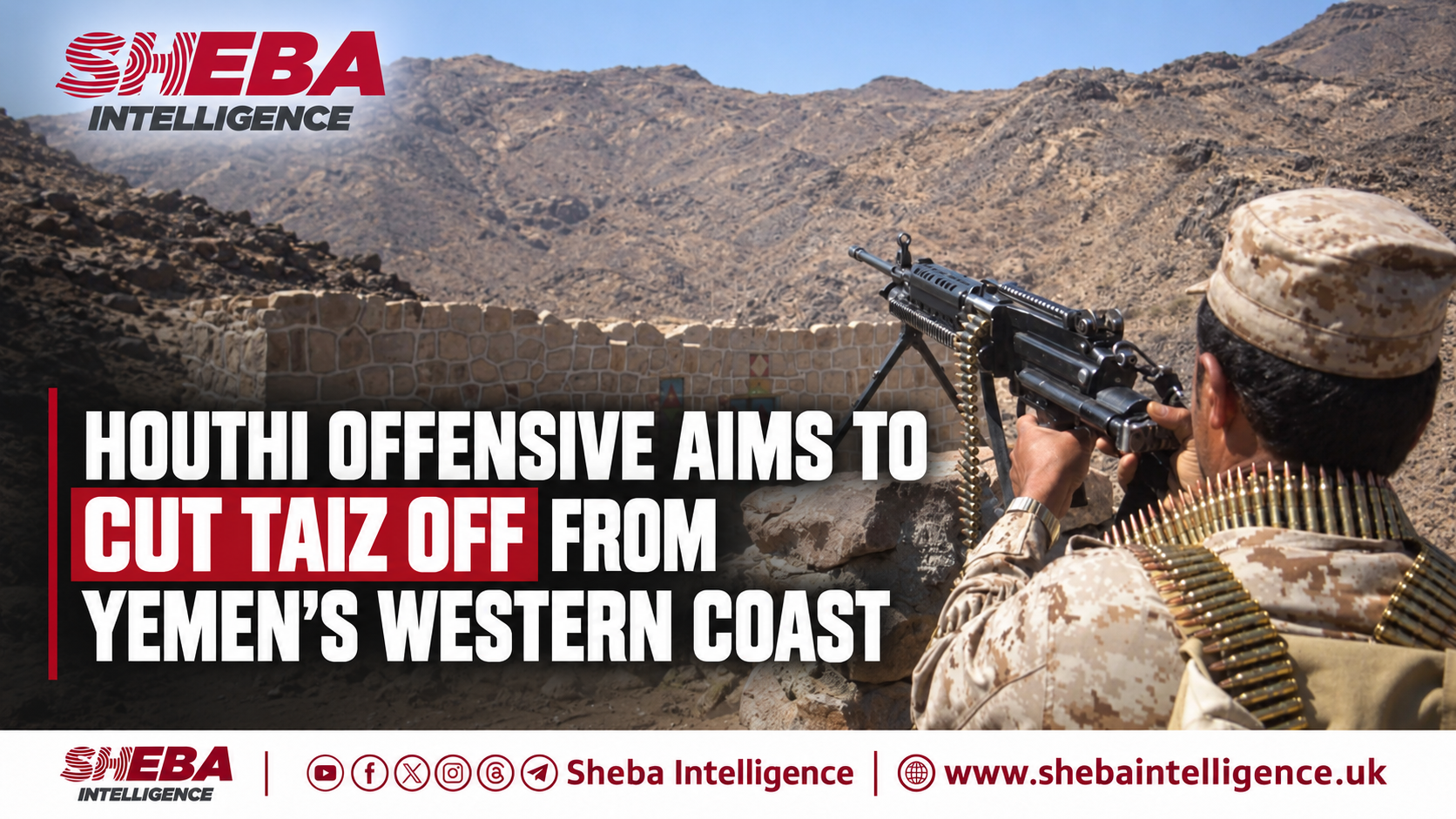
Houthi Offensive Aims to Cut Taiz Off from Yemen’s Western Coast
The Houthis have seized more than six positions in Maqbanah, increasing pressure on the route to Mokha, as government forces launch an air-backed counteroffensive
Houthi forces have captured more than six positions in western Taiz in an apparent attempt to threaten the main route linking the governorate with Mokha and Yemen’s western coast, according to field sources.
The positions are located in the Al-Yaman and Al-Quhayfah subdistricts of Maqbanah and overlook the Al-Kadhah road, which branches from the Taiz–Mokha route and serves as an important supply line for government forces deployed across the western and coastal fronts.
If the Houthis consolidate their gains and advance further, they could place the road under direct pressure, attempt to outflank Jabal Habashi and move closer to the highlands overlooking Dhubab. Such a development would increase pressure on Mokha and the inland defensive belt protecting the approaches to Bab al-Mandab.
The Taiz–Mokha road has not been cut. Government-held territory and several defensive positions still separate the Houthis from the coastal corridor.
Government Counterattack
Government forces launched a counteroffensive and announced the recapture of Al-Khazzan Hill in Jabal Habashi after heavy fighting, followed by nearby Makahinah Hill.
The operation is intended to contain the Houthi penetration, prevent further advances toward Al-Kadhah and secure the routes connecting western Taiz with Mokha.
Reinforcements have also reached government positions across the Taiz and western-coast fronts as fighting continues in Maqbanah, Al-Kadhah and areas along the boundary of Jabal Habashi.
More Than 15 Airstrikes
The Yemeni Armed Forces’ media centre said military aircraft carried out more than 15 airstrikes against Houthi positions, concentrations and vehicles across the western-coast fronts in Taiz and Hodeidah.
Field reports said targets around Hays, the Al-Wazi’iyah junction and Al-Aqmah were among those hit. No official assessment of the damage or casualties caused by the strikes was immediately released.
The air intervention provides direct support to government units attempting to stop the Houthi advance, disrupt reinforcements and recover positions lost during the initial assault.
The Houthis have meanwhile sent additional fighters from Al-Hawban toward western Taiz using buses and civilian vehicles, field sources said. The use of civilian transport appears intended to reduce the likelihood of the reinforcements being detected and targeted from the air.
The number of fighters involved and their final destinations could not be independently confirmed.
Heavy Casualties
The fighting has inflicted significant casualties on both sides. Field sources estimated that about 60 government fighters had been killed since the latest escalation began, while saying Houthi losses were several times higher.
Local media have published the names of 16 prominent Houthi field commanders reportedly killed in the battles around Maqbanah, Al-Kadhah and Al-Barah.
The overall casualty figures and all the names circulated by local media could not be independently verified.
Presidential Leadership Council chairman Rashad Al-Alimi said government forces would not allow the Houthis to advance toward the western coast or threaten Bab al-Mandab. He promised a firm military response and instructed government forces to protect civilians and assist families displaced by the fighting.
Urgent Humanitarian Appeal
Yemen’s Ministry of Planning and International Cooperation issued an urgent appeal warning of a rapidly deteriorating humanitarian situation as the fighting expands across Taiz and Hodeidah.
The ministry said the escalation had caused forced displacement and civilian evacuations while affecting residential areas and sites sheltering displaced people in Mokha, Maqbanah, Jabal Habashi, Mawza, Al-Ma’afer, Al-Wazi’iyah and Dhubab in Taiz, as well as Al-Khawkhah and Hays in Hodeidah.
It called on UN agencies, humanitarian organisations and donors to provide an immediate and coordinated response, including emergency shelter, food, medicines, clean water, sanitation services and field hospitals.
The appeal followed a preliminary government assessment recording the displacement of at least 917 families from Maqbanah and Jabal Habashi. The number could increase as registration continues and more families leave areas close to the fighting.
Weeks of Preparation
The offensive follows weeks of Houthi mobilisation in Maqbanah and western Taiz, including the movement of fighters, ballistic missiles, drones and heavy weapons toward the fronts.
The group subsequently launched coordinated attacks across Maqbanah, Al-Kadhah and Al-Barah while firing missiles and drones toward Mokha, Al-Khawkhah and other coastal areas. Military activity on eastern fronts around Taiz also continued, apparently forcing government forces to divide their personnel and resources.
Government troops previously halted a Houthi attempt to capture Al-Kadhah. However, the latest gains in Maqbanah show that the group remains capable of applying pressure through alternative positions overlooking the road network.
The Houthis also renewed their attacks on Jabal Dubas in Hays, adding pressure on the coastal axis extending toward Al-Khawkhah and Mokha.
Pressure on the Approaches to Bab al-Mandab
The current operation forms part of a wider pattern of Houthi pressure on the inland and coastal defences protecting Mokha and the approaches to Bab al-Mandab.
Sheba Intelligence recently reported a Houthi–Al-Shabaab plan to establish a parallel maritime front along the Somali coast, potentially placing maritime traffic under pressure from both the Yemeni and African sides of the waterway.
The fighting in Maqbanah does not mean the Houthis are close to reaching the strait. Several government defensive lines and extensive government-held territory remain between the group and Bab al-Mandab.
Its immediate significance lies in the attempt to weaken the inland defensive belt, threaten the connection between Taiz and Mokha and stretch government forces across multiple fronts protecting Yemen’s western coast.