Houthis Transport Weapons by Camel to Taiz Peaks After Government Advances in Bab al-Mandab
The coalition spokesperson released footage he described as showing Houthi fighters “fleeing en masse” from their positions as Yemeni government forces advanced in clearing operations around Bab al-Mandab with coalition air support. Meanwhile, local sources reported that the Houthis are stepping up weapons transfers into the Taiz highlands, using camels to reach rugged peaks inaccessible to vehicles.
As government forces consolidated control over Bab al-Mandab, the strategic Kahboub mountains and Mayyun Island, the sources said the Houthis were intensifying their buildup in mountains overlooking coastal areas to the west and south of Taiz, seeking to strengthen their presence on high ground surrounding the conflict zone.
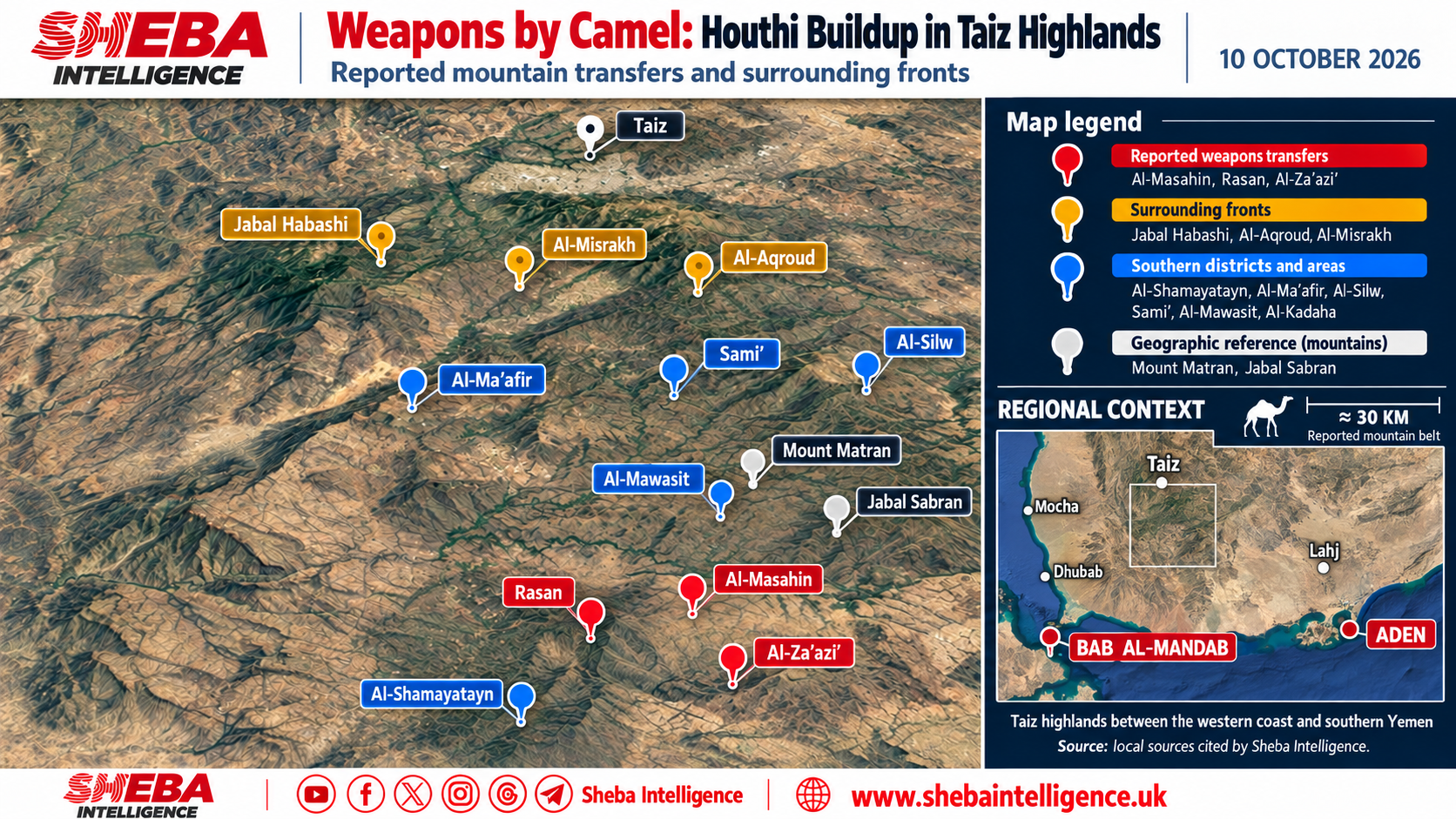
The sources said the weapons transfers cover a mountain range stretching approximately 30 kilometers, including peaks in Al-Masahin, Rasan and Al-Za’azi’. Some of these summits have no vehicle access roads, forcing the group to transport weapons on camelback.
According to the sources, the transfers coincide with an extensive buildup in highlands overlooking the approaches to Bab al-Mandab, Lahj and Aden. The use of camels underscores the importance the Houthis attach to moving weapons into difficult-to-access positions despite the logistical challenges posed by the terrain.
The sources expressed concern that the deployment could be intended to support Houthi forces along the coast and enable an attempt to return to Bab al-Mandab, or prepare for an escalation toward Lahj and Aden if government forces advance toward Mocha and Hodeidah. These remain the sources’ assessments of the buildup; the ultimate purpose of the weapons transfers has not been established.
Assessing factors that could limit the Houthis’ ability to consolidate their deployment, the sources pointed to the effectiveness of air support for government forces and the course of fighting on surrounding fronts, including Jabal Habashi, Al-Aqroud and Al-Misrakh. They said sustained military pressure and disruptions to supplies and reinforcements could weaken the group’s ability to retain its mountain positions and turn them into a persistent threat to the coast and southern areas.
The sources also highlighted the significance of the highlands across Al-Silw, Sami’, Al-Ma’afir and Al-Mawasit, as well as Mount Matran and Jabal Sabran, in the fighting in southern Taiz. These areas are connected to routes leading toward the western coast, Lahj and Aden, linking developments in the highlands to the security of government gains around Bab al-Mandab.
In its October 7 report on Houthi deployments in the Taiz highlands, Sheba Intelligence reported that Houthi forces had expanded their presence in Al-Turbah, Al-Silw and Sami’ after withdrawing from positions in Dhubab and Bab al-Mandab. Field sources said control of Al-Turbah gave the group leverage over the road linking Taiz to Aden through the southern countryside, increasing pressure on one of the city’s principal access routes. Positions in the Al-Silw and Sami’ highlands also overlook surrounding areas and routes leading toward the western coast.
The same report noted that government forces had reached the outskirts of Mocha before returning to consolidate their positions in Dhubab and deploying in Al-Wazi’iyah to secure their coastal gains and the areas behind their advancing units. This places the latest Houthi buildup within the wider struggle over the coast, the highlands and the roads connecting Taiz with southern Yemen.