
Drones Reshape Yemen’s Escalation as Government Forces Disrupt Houthi Advances
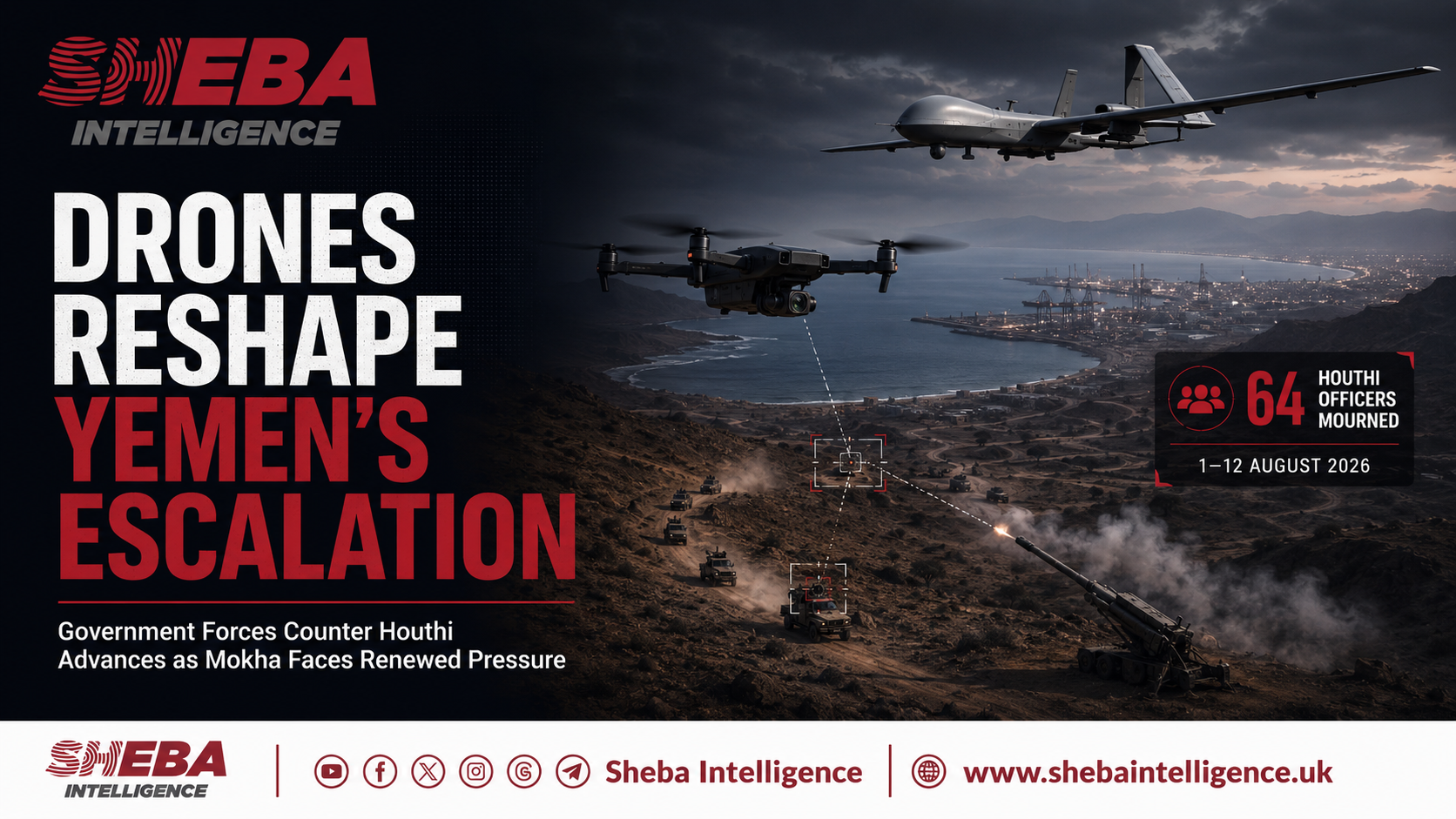
Drones and drone-directed artillery have become the principal battlefield tools used by Yemeni government forces to counter Houthi concentrations, reinforcements and attempted ground advances. The Houthis, meanwhile, are relying heavily on unmanned aircraft to maintain pressure on Mokha and government positions along the southern Hodeidah front.
Information obtained by Sheba Intelligence indicates that the Houthis are preparing to launch drones from Hodeidah military airport. The preparations coincide with repeated movements by drone specialists south of Al-Jah, pointing to possible renewed attacks against Mokha and government-held areas in southern Hodeidah.
From Battlefield Support to a Targeting System
Recent operations show that government drones are no longer being used solely for reconnaissance or isolated strikes. They now form part of an integrated targeting system that detects Houthi movements, transmits coordinates, corrects artillery fire and assesses the results.
Government forces have released footage of drones targeting Houthi concentrations and vehicles in Al-Jawf, while similar operations have been reported in Taiz, Hajjah, Al-Dhalea and Marib. This combination of aerial surveillance and directed artillery allows government units to engage reinforcements and mobile targets before they reach the front line or develop into larger assaults.
Sheba Intelligence documented the emergence of this capability in two previous investigations. The first examined the deployment of tactical drones for reconnaissance, munition drops and artillery correction across several fronts. A follow-up investigation identified the G50 fixed-wing VTOL drone in operations on the Saada front, revealing a longer-endurance platform capable of carrying advanced surveillance equipment and potentially guided munitions.
The current escalation confirms that these systems have moved beyond limited experimentation. Tactical drones are now supporting routine operations across multiple fronts, while the strategic platform demonstrated in Saada provides greater range and endurance for operations against higher-value targets.
Houthi Ground Pressure Under Drone Cover
The Houthis continue to activate several fronts while attempting limited ground advances in parts of Taiz, Marib and Al-Jawf.
In Hayfan, southern Taiz, Houthi forces attempted to advance towards government positions in Al-Athawir under drone and artillery cover. Forces from the Fourth Hazm Brigade repelled the assault after clashes that caused casualties on both sides. Government units also reported disrupting infiltration attempts across the Harib, Ain, Bayhan and Upper Markha fronts.
The two sides are using drones for different operational purposes. The Houthis employ them to pressure fixed positions, cover advancing units and extend attacks beyond the front lines. Government forces use them primarily to expose concentrations, direct artillery and strike reinforcements before they can be deployed.
Mokha and the Defence of Hodeidah
Mokha remains the main focus of Houthi drone pressure on the western coast, alongside the use of ballistic missiles and unmanned explosive boats. The reported preparations at Hodeidah airport and the activity of specialists south of Al-Jah suggest that the coastal campaign is continuing.
A previous Sheba Intelligence report examined the strategic reasons behind the repeated attacks on Mokha. The port is a logistical hub for government forces on the western coast and could support a future military operation towards Hodeidah.
Sustained pressure on Mokha therefore serves two objectives: disrupting a potential military supply route and pre-emptively protecting Hodeidah. The latter remains one of the Houthis’ most valuable strategic areas but is also among their most exposed positions in the event of a government offensive from the western coast.
Officer Losses and the Cost of Escalation
Houthi funeral announcements issued between August 1 and 12 identified 64 dead officers: two brigadier generals, 13 colonels, six lieutenant colonels, 10 majors, 12 captains and 21 lieutenants of different grades.
Thirty-one held the rank of major or above, including 15 brigadier generals and colonels. Such a high proportion may indicate that recent attacks reached field command elements, operational teams and troop concentrations rather than individual fighters alone.
The figure does not represent the full scale of Houthi losses. If each announced officer was killed alongside only three to eight other fighters, total deaths associated with these incidents could fall broadly between 250 and 600. This is an analytical range rather than a confirmed casualty count.
The estimate must also account for the inflation or honorary use of military ranks within the Houthi structure. Funeral announcements can be delayed, and the available information does not establish that all 64 officers were killed during the same 12-day period or by government drone operations.
Nevertheless, the timing of the announcements coincides with the expanded use of government drones and drone-corrected artillery. This strengthens the assessment that improved surveillance and faster targeting are increasing the cost of Houthi concentrations and ground movements.
A More Integrated Government Response
Presidential Leadership Council Chairman Rashad Al-Alimi described the integration of Yemen’s fronts as the most important recent military development. He said Marib was no longer confronting the Houthis alone, citing simultaneous activity from Taiz, Shabwa, Al-Dhalea, Lahj, Hajjah and Saada.
Al-Alimi said government forces now operate through a unified command structure and warned that no further Houthi attack would go unanswered or face no “integrated deterrent response.”
Drones provide the operational foundation for this approach. By linking surveillance, artillery and ground units across dispersed fronts, they allow government forces to detect Houthi movements and respond before an attack achieves momentum.
The significance of the latest escalation lies not simply in the number of drone strikes, but in the emergence of a shorter and more precise targeting cycle. That shift is beginning to limit the Houthis’ ability to concentrate forces, move reinforcements and launch ground assaults without being detected and engaged.