
Yemen’s Drone War: Long-Range Strike Capabilities Have Yet to Enter Combat
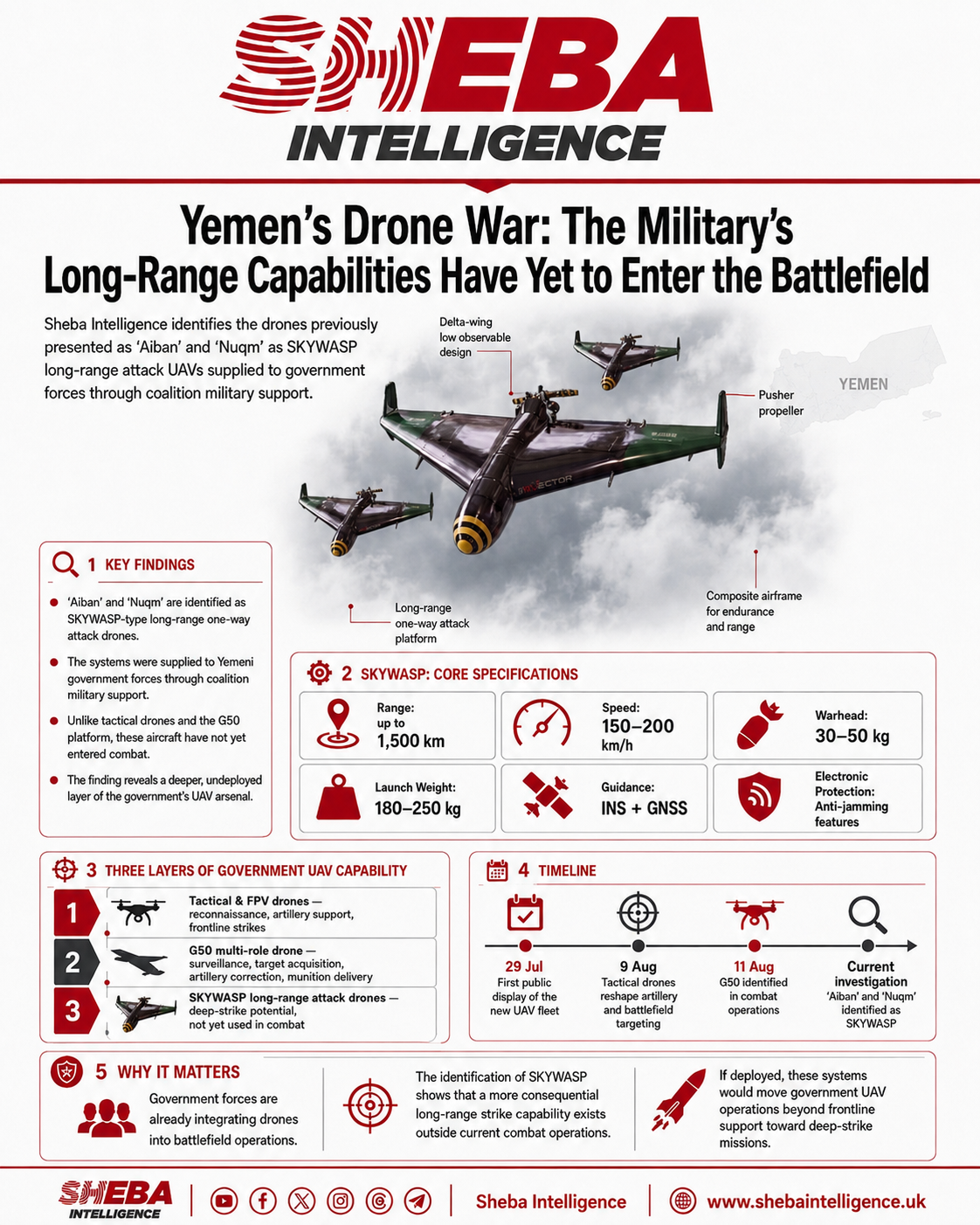
Sheba Intelligence identifies the UAVs previously presented as “Aiban” and “Nuqm” as SKYWASP long-range attack drones supplied to government forces through coalition military support.
Sheba Intelligence has identified a previously undisclosed layer of the Yemeni government’s drone arsenal: long-range attack UAVs supplied as part of military support from the Saudi-led coalition that have not yet been used in combat.
A Sheba Intelligence investigator examined the aircraft, traced their development and production chain, and compared their configuration with known systems. The investigation identified the two UAVs previously presented by Yemeni Defense Minister Lt. Gen. Taher Al-Oqaili under the names “Aiban” and “Nuqm” as SKYWASP-type long-range one-way attack drones.
The finding clarifies a major question left open after the Yemeni Ministry of Defense publicly displayed its new UAV fleet in late July. At the time, Sheba Intelligence’s visual analysis established that government forces possessed several distinct classes of unmanned aircraft, but the available footage was insufficient to conclusively associate the announced names with individual platforms or independently establish their range, payload and guidance systems.
The new investigation goes further. It identifies the origin and capabilities of the two aircraft and finds that they reached Yemeni government forces through military support provided by the coalition backing the internationally recognized government.
More importantly, unlike several other UAV systems now operating on Yemen’s frontlines, the SKYWASP aircraft identified by Sheba Intelligence have not yet entered combat.
From “Aiban” and “Nuqm” to SKYWASP
During the first public presentation of the government’s expanding UAV fleet, the Ministry of Defense displayed several larger aircraft alongside significant numbers of smaller tactical drones. Sheba Intelligence assessed at the time that the variety and quantity of systems pointed to an emerging multi-layer unmanned aviation capability rather than a collection of isolated prototypes.
The names Aiban and Nuqm, however, could not then be reliably matched to specific aircraft from the public material alone.
Follow-up investigation has now identified the two aircraft presented under those names as SKYWASP, a long-range one-way attack UAV developed through a Saudi-US defense partnership.
Available documentation identifies Vector2SR as the developer, a joint venture involving Saudi SR2 Defense Systems and the US company Vector.
For the Yemen investigation, the significance lies less in the industrial background of the aircraft than in its transfer to government forces. Sheba Intelligence’s findings indicate that the systems were provided within the broader military assistance delivered by the coalition supporting Yemen’s internationally recognized government.
A 1,500-Kilometre Strike System
The SKYWASP represents a substantial step beyond the tactical drones currently visible in government combat operations.
Available specifications give the aircraft an operational range of up to 1,500 kilometres, a speed of approximately 150–200 km/h, and an explosive warhead weighing between 30 and 50 kilograms. Its total launch weight is estimated at between 180 and 250 kilograms.
The aircraft follows pre-programmed navigation points and combines inertial navigation with satellite-based guidance. Available technical information also indicates measures intended to improve resistance to electronic jamming.
These characteristics place it in a fundamentally different category from reconnaissance quadcopters, artillery-correction drones and short-range strike systems operating close to the frontline.
Its purpose is not simply to improve the accuracy of battlefield fire. It provides the potential to strike targets far beyond the immediate combat zone.
Government Drones Are Already Reshaping the Frontline
The discovery comes as government forces are rapidly expanding their operational use of smaller UAVs.
Previous Sheba Intelligence investigations documented tactical drones being used in Marib, Al-Dhalea and other fronts to detect Houthi movements, identify targets, observe artillery impacts and correct subsequent fire. This has increasingly integrated UAV reconnaissance directly into the government’s artillery targeting cycle.
That development marked the first layer of a broader transformation: inexpensive UAVs acting as persistent aerial observers for ground forces and artillery units.
The transformation subsequently moved beyond small reconnaissance platforms.
The G50 Has Already Entered Combat
On the Saada front, Sheba Intelligence identified a significantly heavier platform operating against Houthi positions.
A follow-up investigation assessed the aircraft as most likely the DSTECHUAS G50 Heavy Load VTOL Fixed-Wing Drone, a Chinese commercial and industrial platform modified for military use by Yemeni government forces. Footage indicated that it was being used for surveillance, target acquisition, artillery correction and the delivery of munitions.
The G50 can carry payloads of up to approximately 15 kilograms, has an assessed control range of 50–150 kilometres, and can remain airborne for several hours depending on payload and configuration.
Its appearance demonstrated that government forces had progressed beyond small tactical drones and had begun adapting heavier dual-use platforms for direct combat missions.
The SKYWASP represents another step again.
Unlike the G50, which is a reusable multi-role platform adapted for battlefield operations, SKYWASP is designed as a long-range one-way attack system.
FPV Warfare Expands on Both Sides
At the opposite end of the spectrum, Yemen is also witnessing the rapid expansion of FPV drone warfare.
Sheba Intelligence previously documented a suspected Houthi FPV drone recovered by government forces in Marib on August 11. Evidence indicated a fiber-optic control link, allowing the operator to retain command and live video without relying on a conventional radio-frequency connection vulnerable to ordinary electronic jamming.
FPV systems are designed for a different battlefield altogether. They are relatively inexpensive precision weapons capable of attacking individual vehicles, artillery pieces, positions or personnel near the frontline.
Since that investigation, FPV drones have also appeared with Yemeni government forces, according to information monitored by Sheba Intelligence.
This means the tactical drone race is increasingly developing on both sides of Yemen’s frontlines. Small UAVs are being integrated into reconnaissance, artillery support and direct attack, while more capable platforms are extending the depth and duration of government operations.
Three Layers of Government UAV Capability
Taken together, Sheba Intelligence’s investigations now reveal a more structured picture of the Yemeni government’s emerging drone force.
At the tactical level are small reconnaissance and FPV drones, designed to operate around the immediate battlefield and support or conduct precision attacks.
A second layer consists of heavier multi-role platforms such as the G50, capable of longer endurance, greater payloads and operations beyond the immediate frontline. This layer has already entered combat.
The third layer consists of long-range one-way attack systems such as the SKYWASP aircraft identified in this investigation.
It is this third layer that remains unused.
The distinction is important. Government forces are already fighting with drones, but the systems currently visible in combat do not represent the full unmanned capability now available to them.
A Capability Still Held Outside the War
For much of Yemen’s conflict, the Houthis maintained a significant advantage in long-range missiles and unmanned attack systems, while government forces relied primarily on conventional ground firepower and comparatively limited UAV capabilities.
Recent developments show that this gap is changing in more than one direction.
Tactical drones are improving reconnaissance and artillery effectiveness. FPV systems are opening a low-cost precision-strike dimension. The modified G50 has demonstrated the ability to conduct longer-duration reconnaissance and strike missions behind frontline positions.
The identification of Aiban and Nuqm as SKYWASP long-range attack drones, however, reveals a capability of a different scale.
With an estimated range of up to 1,500 kilometres and a substantially larger warhead than the systems currently seen in government battlefield operations, these aircraft could extend government strike capability well beyond the frontlines.
Yet Sheba Intelligence’s investigation found that they have not been used in the war so far.
That may be the most important conclusion of the investigation.
The Yemeni military’s July display was initially significant because it revealed the existence of a broader UAV fleet. Subsequent combat footage showed that parts of that fleet and other UAV platforms were already being integrated into operations.
Sheba Intelligence can now establish that another, more consequential capability remains outside the battlefield: long-range attack drones supplied through coalition military support and capable of moving government UAV operations from tactical battlefield support toward deep-strike missions.
If these systems are eventually deployed, their significance will not lie simply in adding another drone to Yemen’s war. They would mark the entry of a new long-range strike capability into the government’s operational arsenal.