
Houthi Breakthrough in Western Taiz Threatens Routes to Mokha and Aden
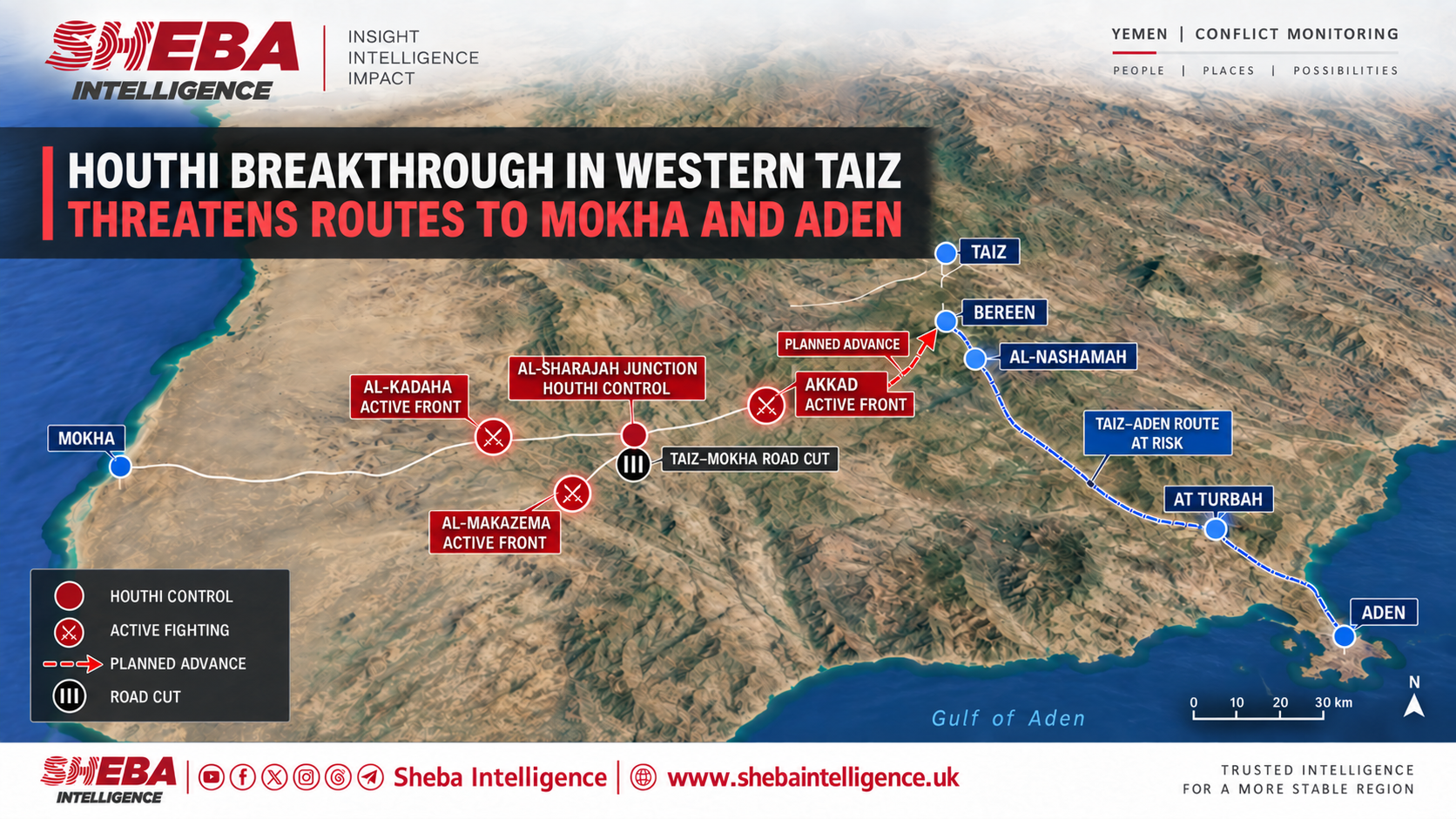
Houthi forces have expanded their offensive in western and southwestern Taiz, reaching the Al-Sharajah junction and threatening two key routes connecting the city with the Red Sea coast and southern Yemen, according to field sources.
Fighting is continuing in Al-Makazemah and Akkad along an axis that could lead towards Al-Birein, a strategic transport junction about 15 kilometres from the current clashes.
The Houthis have not reached Al-Birein. However, a further advance beyond Akkad could bring them closer to the main road linking Taiz with Al-Nashamah, Al-Turbah and the interim capital Aden.
Taiz–Mokha Road Remains Cut
The latest advance follows a Houthi breakthrough around Al-Kadaha, a strategically located area between the districts of Al-Ma’afer, Jabal Habashi, Maqbanah and Al-Wazi’iyah.
Local sources said Houthi forces reached parts of Al-Kadaha and cut the Taiz–Mokha road. Traffic remains disrupted as fighting continues around the route, which serves as a major supply line between Taiz and Yemen’s government-held western coast.
Government forces and West Coast units have sent reinforcements to Al-Kadaha and Maqbanah and launched counterattacks aimed at recovering positions, reopening the road and preventing the Houthis from consolidating their breakthrough.
The fighting remains fluid, with the Houthis seeking to hold newly reached positions and seize high ground overlooking the route, while government forces attempt to contain the advance.
Fighting Moves Closer to the Aden Corridor
Al-Birein is significant because it lies on the transport network connecting Taiz with Al-Nashamah, Al-Turbah and Aden. Although fighting remains concentrated in Al-Makazemah and Akkad, the direction of the offensive indicates that Al-Birein could be the Houthis’ next objective.
Reaching elevated positions near the area could allow the group to threaten the southern route with drones, artillery or other indirect fire without having to capture Al-Birein itself.
The offensive therefore appears to have moved beyond an attempt to separate Taiz from Mokha and the western coast. By cutting the Mokha road and pushing along an axis that could threaten the Aden corridor, the Houthis may be seeking to place two of the city’s most important access routes under simultaneous pressure.
Risk of Renewed Siege
If the Houthis maintain their hold over the Taiz–Mokha road and later succeed in cutting the Taiz–Al-Turbah–Aden route, the city could again face conditions resembling the siege imposed in 2015, but with potentially greater intensity.
The two roads carry civilian traffic and essential supplies, including food, medicine, fuel and cooking gas. Losing access to both would isolate Taiz from the western coast and the south, force commercial vehicles onto longer and more dangerous mountain roads and sharply increase the economic and humanitarian pressure on its population.
The threat does not depend entirely on capturing the roads. Reaching nearby high ground and bringing the routes within drone or artillery range could be sufficient to disrupt traffic and make regular supply movements increasingly dangerous.
Pressure on Jabal Habashi
The Houthi arrival at the Al-Sharajah junction could also increase pressure on government forces in Jabal Habashi.
The fighting around Al-Kadaha, Al-Makazemah and Akkad threatens government supply lines from several directions and could force defending units to divide their strength between holding frontline positions, protecting roads and containing further breaches.
Control of nearby high ground would allow the Houthis to disrupt troop movements and logistics without having to capture large areas of territory.
A Broader Offensive
The escalation follows weeks of Houthi mobilisation across Maqbanah, Al-Kadaha, Jabal Habashi, Al-Barh and Hays, accompanied by missile and drone attacks against government and West Coast forces.
The initial operations appeared focused on reaching positions overlooking the Taiz–Mokha road and separating the city from the western coast. The subsequent arrival at Al-Sharajah junction and the fighting in Al-Makazemah and Akkad point to a broader effort to threaten Taiz’s connections with both Mokha and Aden.
Any further advance towards Al-Birein would also take the fighting deeper into the densely populated Al-Ma’afer district, which has remained relatively distant from the main front lines.
Humanitarian Risks
The continued closure of the Taiz–Mokha road could disrupt the flow of basic commodities and increase transportation costs. Fighting and shelling have already displaced families from communities near the front.
Local reports also said drones struck the Al-Kadaha–Al-Birein road while displaced civilians were travelling along it, raising the risk of further casualties and displacement if the fighting moves closer to populated parts of Al-Ma’afer.
Prospects for Restoring the Balance
The government’s ability to contain the breakthrough will depend on how quickly it can coordinate forces from Taiz and the West Coast, reinforce threatened positions and secure the road network.
A unified response combining reinforcements, mobile reserves, aerial surveillance and counter-drone capabilities could prevent the Houthis from consolidating their gains or extending the offensive beyond Akkad.
Deploying the government’s drone brigade for reconnaissance, early warning and battlefield monitoring, alongside coordinated air support to disrupt incoming Houthi reinforcements, could help restore the balance and support efforts to reopen the Mokha road.
Pressure on other fronts could also force the Houthis to disperse their forces rather than concentrate them in western Taiz. If the government response remains fragmented, however, the current breakthrough could develop into a broader attempt to reimpose the isolation and siege conditions Taiz experienced after the war began in 2015.