
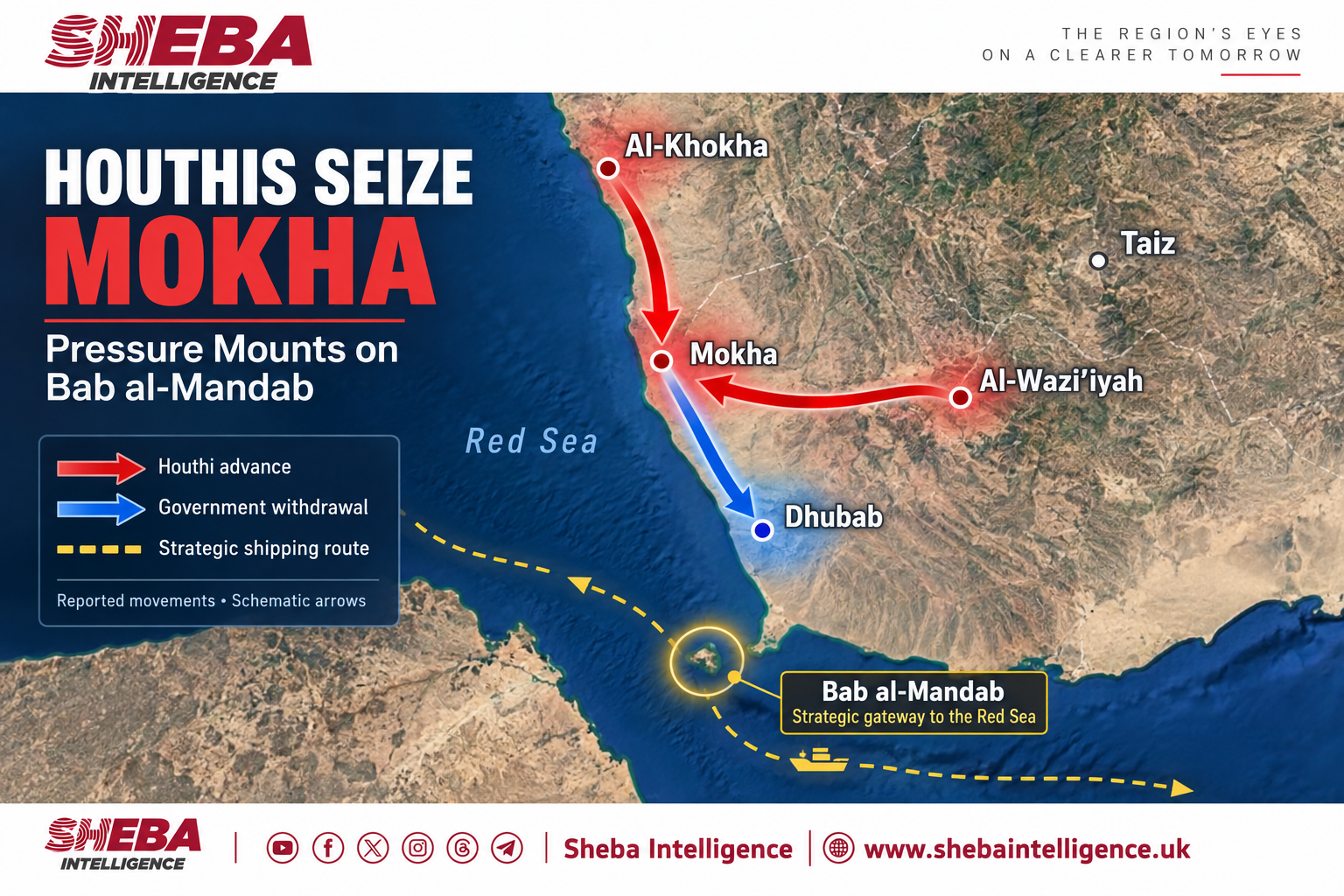
Houthi forces have seized the coastal city of Mokha in western Taiz governorate, shifting the battle towards the defence of the approaches to Bab al-Mandab after successive government withdrawals from Hays, Al-Khokha and Khalid bin al-Walid military camp. Government forces and their allies are now redeploying south towards Dhubab.
The fall of Mokha, the headquarters of the National Resistance, follows warnings published by Sheba Intelligence about a multi-axis offensive intended to weaken western-coast defences, sever their links with the Taiz fronts and open routes towards the strait.
Military sources told Sheba Intelligence in a report published on September 9 that government forces had withdrawn from Hays and Al-Khokha to reinforce Mokha’s defences following a major Houthi assault involving missiles, drones and successive waves of fighters. The withdrawal followed a breakthrough in Al-Wazi’iyah and the Houthis’ entry into Khalid bin al-Walid camp.
According to field information received by Sheba Intelligence, the loss of the camp marked a turning point in the battle. Houthi forces subsequently advanced into Jabal Al-Nar, where the coalition’s joint operations centre is located, before pressing towards Mokha from Al-Wazi’iyah and along the coast.
In response to the retreat, Lieutenant General Tareq Saleh, deputy chairman of the Presidential Leadership Council and commander of the National Resistance, ordered forces on the western coast to regroup. In a statement carried by the National Resistance’s military media, Saleh said: “We have ordered the establishment of an alternative command centre in a secure location to regroup the forces, in consultation with the Arab coalition command and the Presidential Leadership Council.”
He said National Resistance, Giants Brigades, Nation’s Shield and Taiz Military Axis units had suffered deaths and injuries while resisting the offensive. He accused Iran of planning and supporting the assault, with its allies participating.
A review of earlier Sheba Intelligence reporting reveals several warning signs preceding the latest collapse. On September 3, the platform reported an assault in Maqbanah following weeks of mobilisation, including the movement of fighters, missiles, drones and heavy weapons towards the Taiz fronts. The report noted that simultaneous pressure on eastern and western fronts could stretch government forces and limit their ability to reinforce coastal defences.
In its September 4 report on the attempt to cut Taiz off from the western coast, Sheba Intelligence warned that consolidating Houthi gains in Maqbanah could threaten supply routes, enable the group to outflank defensive positions and increase pressure on Mokha and the inland areas protecting the approaches to Bab al-Mandab. At the time, the report distinguished between the risk of further advances and actually reaching the strait, which remained separated from Houthi positions by government defensive lines.
On September 8, the platform published details of a plan attributed by a source in Hodeidah to Iran’s Islamic Revolutionary Guard Corps. The plan envisaged retaking Hays, reaching Al-Khokha and linking coastal operations with fighting in Maqbanah. It identified Al-Tuhayta as an axis for a coastal flanking manoeuvre, while Al-Jabaliyah, Al-Fazah and Al-Jah would serve as fronts to wear down government forces and restrict the movement of reinforcements.
The report said an earlier push through Al-Wazi’iyah towards Dhubab had been thwarted by airstrikes and ground reinforcements, according to field information available at the time. The broader objective of advancing towards Bab al-Mandab, however, remained in place. Recent movements are consistent with the directions of attack described in that report, although this alone does not independently establish every detail of the plan or the involvement of the parties named.
The coastal retreat contrasts with developments on the eastern fronts. On September 9, Sheba Intelligence reported government advances towards Maas Camp in Marib and Baraqish in Al-Jawf, alongside orders from Abdul-Malik al-Houthi to deploy elite ideological units to reinforce both fronts. This divergence suggests that Houthi gains on the coast do not necessarily reflect a similar advantage elsewhere on the battlefield.
The accelerating withdrawals also recall earlier reversals that reshaped territorial control, including the loss of government positions in Nihm in January 2020 and the Joint Forces’ withdrawal from positions around and south of Hodeidah in November 2021. The differing circumstances of these events, however, preclude a single explanation.
Circulating field accounts include allegations that communications were compromised and commanders’ voices imitated to issue withdrawal orders. No technical evidence or publicly released investigation findings have established these claims or their impact on the battle. They therefore cannot be treated as a proven explanation for the retreat.
Each setback also brings renewed accusations of betrayal among the various government-aligned forces, whose objectives differ.
The implications extend offshore to islands in the Red Sea. Capturing coastal areas could help the Houthis threaten access and supply routes to nearby islands, potentially facilitating further advances at sea. However, the islands’ administrative affiliation with mainland districts does not mean that control automatically passes to the force holding the coast. Reuters reported attacks on the Hanish Islands, citing government military sources; this does not establish that the Houthis have captured those islands or all islands associated with the newly seized coastal areas.
The loss of Mokha shifts the military focus towards defending Dhubab and the approaches to Bab al-Mandab. Although control of the city does not amount to control of the strait, an expanded Houthi presence further south could provide additional positions from which to threaten shipping and increase the likelihood of a stronger regional and international response. The course of the fighting will depend on whether government forces can restore cohesion and stabilise their defensive lines, and whether the Houthis can retain their gains and sustain their advance.