
Names and Locations: Yemen Unveils Alleged Iranian Command Network Behind Houthi Military Operations
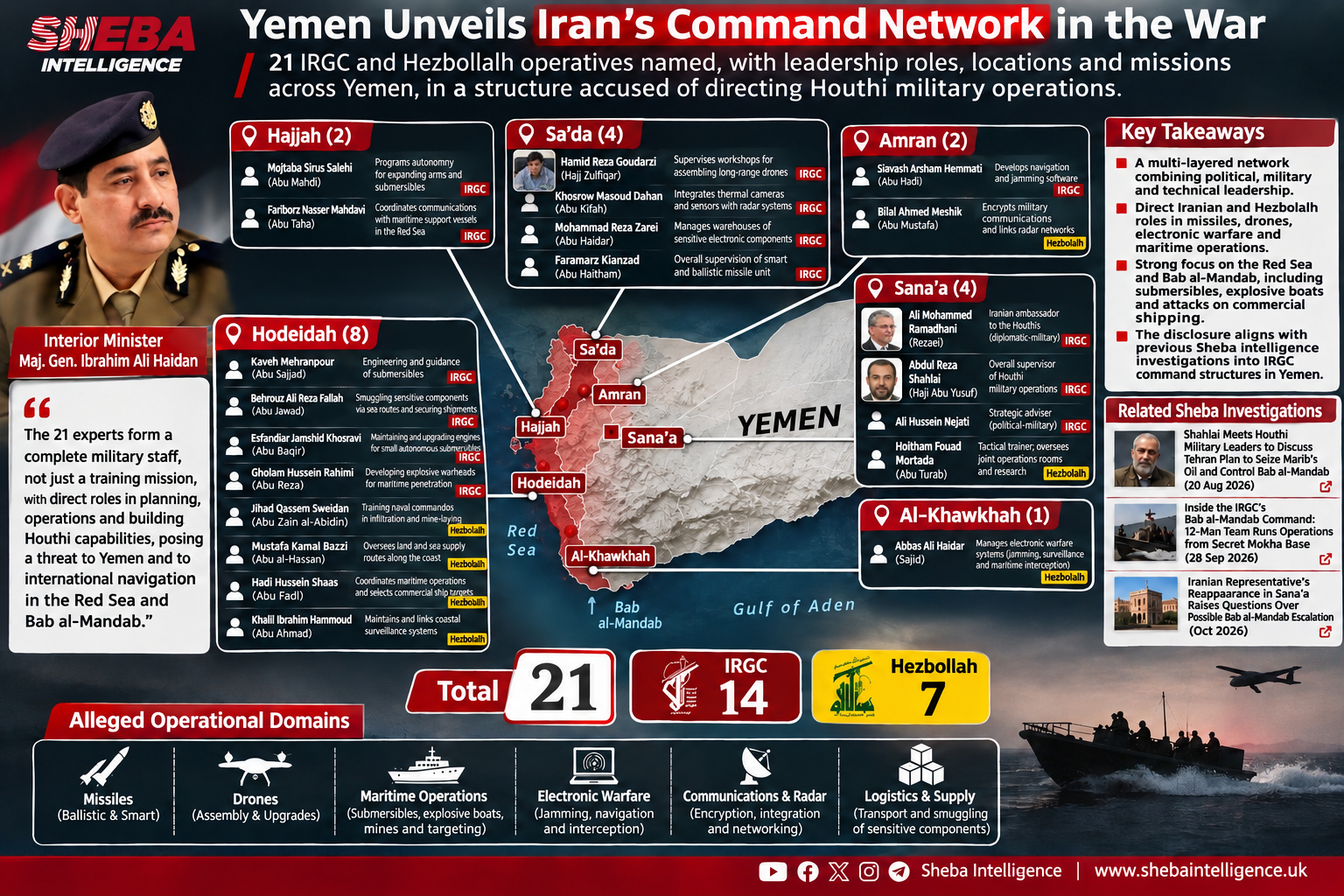
Government list identifies 21 alleged IRGC and Hezbollah operatives, including Abdul Reza Shahlai, and details military, technical and maritime roles that intersect with earlier Sheba Intelligence investigations into Yemen’s war and Bab al-Mandab
A list released by Yemen’s Interior Ministry identifies 21 Iranian and Lebanese individuals allegedly involved in a military command and supervisory network working with the Houthis, with responsibilities ranging from operational planning and battlefield management to missile development, drones, electronic warfare and maritime operations in the Red Sea and Bab al-Mandab.
The list identifies Abdul Reza Shahlai, also known as “Hajj Abu Yusuf,” as the overall supervisor of Houthi military operations. It also names individuals the ministry associates with Iran’s Islamic Revolutionary Guard Corps (IRGC) and Lebanon’s Hezbollah, including political and military advisers, joint operations personnel, missile specialists, naval experts and communications officers.
The detailed disclosure follows a statement by Yemen’s Interior Minister, Major General Ibrahim Ali Haidan, who said 14 IRGC personnel and seven Hezbollah members were working with the Houthis. According to Haidan, their alleged involvement extends beyond supplying weapons and training to directly supervising military planning, operations and the development of advanced capabilities.
Sheba Intelligence previously reported the minister’s announcement. The newly released names, locations and assignments provide a more detailed account of the alleged foreign military structure.
The disclosure also intersects with earlier Sheba Intelligence investigations into Shahlai’s reported role in military coordination and Iranian command networks operating along Yemen’s western coast and around Bab al-Mandab.
Only Three of the 21 Named Individuals Pictured
Although the Interior Ministry’s list identifies 21 alleged IRGC and Hezbollah personnel, the released graphics include photographs of only three individuals: Ali Mohammed Ramadhani, also known as “Rezaei”; Abdul Reza Shahlai, known as “Hajj Abu Yusuf”; and Brigadier General Hamid Reza Goudarzi, known as “Hajj Zulfiqar.” The remaining individuals are identified by name and alleged responsibilities without accompanying personal photographs. The ministry has not explained why images were released for only these three individuals or whether photographs of the others are available.
Sana’a: Political-Military Leadership and Joint Operations
The ministry identifies four individuals based in Sana’a, three allegedly affiliated with the IRGC and one with Hezbollah.
The first is Ali Mohammed Ramadhani, also known as Rezaei, described as an Iranian military-diplomatic figure serving as Tehran’s ambassador to the Houthis.
The list identifies Abdul Reza Shahlai, known as “Hajj Abu Yusuf,” as a military adviser and overall supervisor responsible for managing and implementing Houthi military operations.
It also names Ali Hussein Nejati as a strategic adviser exercising political and military oversight.
The fourth individual, Haitham Fouad Mortada, known as “Abu Turab,” is identified as a Hezbollah tactical trainer allegedly responsible for supervising joint operations rooms and research activities.
According to the ministry’s account, these roles place Sana’a at the centre of the alleged command structure, linking political oversight, military planning and operational management.
Saada: Ballistic Missiles and Long-Range Drones
In Saada, the ministry names four individuals allegedly affiliated with the IRGC and involved in missile, drone and technical development.
Brigadier General Hamid Reza Goudarzi, known as “Hajj Zulfiqar,” is identified as supervising workshops assembling long-range drones.
Brigadier General Faramarz Kianzad, known as “Abu Haitham,” is described as overseeing a unit responsible for advanced and ballistic missile systems.
The list also names Major Khosrow Masoud Dahfan, known as “Abu Kifah,” as a specialist integrating thermal cameras and sensors with radar systems.
Mohammad Reza Zarei, known as “Abu Haidar,” is identified as a logistics specialist responsible for warehouses storing sensitive electronic components.
The ministry’s descriptions suggest alleged involvement in developing, maintaining and supplying advanced weapons systems rather than providing conventional military training alone.
Amran: Navigation Software and Military Communications
In Amran, the ministry identifies Siavash Arsham Hemmati, known as “Abu Hadi,” as an IRGC-linked software engineer allegedly involved in navigation and electronic-jamming programmes.
It also names Bilal Ahmed Meshik, known as “Abu Mustafa,” as a Hezbollah communications specialist responsible for encrypting military networks and connecting radar systems.
These assignments, if confirmed, would indicate a technical component supporting military communications, navigation and command-and-control capabilities.
However, the published descriptions do not independently establish how the alleged personnel communicate or coordinate across different locations.
Hodeidah: Maritime Operations, Logistics and Commercial Shipping
Hodeidah accounts for the largest group in the ministry’s list, with eight individuals: four allegedly linked to the IRGC and four to Hezbollah.
Their reported responsibilities cover unmanned underwater systems, sensitive-component shipments, maritime surveillance, logistical networks and the coordination of attacks against commercial shipping.
Among the IRGC-linked personnel, Kaveh Mehranpour, known as “Abu Sajjad,” is described as a technical specialist in underwater vehicle engineering and guidance.
Major Behrouz Ali Reza Fallah, known as “Abu Jawad,” is allegedly responsible for moving sensitive components through maritime routes and securing shipments.
Esfandiar Jamshid Khosravi, known as “Abu Baqir,” is identified as a specialist in maintaining and developing engines for small autonomous underwater vehicles.
Colonel Gholam Hussein Rahimi, known as “Abu Reza,” is described as working on explosive warheads intended for maritime penetration missions.
The four individuals allegedly affiliated with Hezbollah include Jihad Qassem Sweidan, known as “Abu Zain al-Abidin,” identified as a maritime operations adviser responsible for training naval commandos in infiltration and mine-laying techniques.
Mustafa Kamal Bazzi, known as “Abu al-Hassan,” is described as a logistics adviser overseeing coastal land and maritime supply routes.
Hadi Hussein Shaas, known as “Abu Fadl,” is identified as a field commander allegedly responsible for coordinating maritime operations and selecting commercial vessels for targeting.
Khalil Ibrahim Hammoud, known as “Abu Ahmed,” is described as a technical specialist responsible for maintaining and integrating coastal surveillance systems.
The concentration of these alleged assignments suggests that Hodeidah occupies a central position in the maritime structure described by the ministry, combining equipment development, logistics, surveillance and operational coordination.
Hajjah and Al-Khawkhah: Maritime Guidance and Electronic Warfare
In Hajjah, the ministry identifies Lieutenant Colonel Mojtaba Sirus Salehi, known as “Abu Mahdi,” as an IRGC-linked engineer allegedly responsible for programming autonomous guidance systems used in explosive-laden boats and unmanned underwater vehicles.
It also names Naval Colonel Fariborz Nasser Mahdavi, known as “Abu Taha,” as responsible for coordinating communications with maritime support vessels operating in the Red Sea.
In Al-Khawkhah, the ministry identifies Abbas Ali Haidar, known as “Sajid,” as a Hezbollah electronic-warfare specialist allegedly managing maritime jamming, surveillance and interception systems.
The list places the 21 individuals across five Yemeni governorates, while separately identifying Al-Khawkhah, which is administratively part of Hodeidah governorate. This accounts for the six geographical entries cited in the government statement.
Earlier Sheba Intelligence Investigations Identified Iranian Command Structures
The new government disclosure intersects with a series of investigations published by Sheba Intelligence over recent months concerning alleged IRGC involvement in Houthi military operations and the development of command-and-control networks along Yemen’s western coast.
On August 20, 2026, Sheba Intelligence published an investigation titled “Shahlai Meets Houthi Military Leaders to Discuss Tehran Plan to Seize Marib’s Oil and Control Bab al-Mandab”.
Citing intelligence sources, the investigation reported that Shahlai had toured Houthi-controlled fronts and met senior military leaders to discuss preparations for a wider campaign involving Marib and Yemen’s western coast.
The report described Shahlai as playing a central role in coordinating military preparations and assessing frontline readiness. That account intersects with the Interior Ministry’s latest identification of him as the overall supervisor of Houthi military operations.
On August 22, Sheba Intelligence also reported the appearance of a new IRGC officer in Sana’a amid an alleged reinforcement of Iran’s military presence.
The investigation cited sources describing the arrival of Iranian officers and Hezbollah-linked specialists to strengthen Houthi operational planning and technical capabilities.
A further investigation, published on September 28 under the title “Inside the IRGC’s Bab al-Mandab Command: 12-Man Team Runs Operations from Secret Mokha Base”, described an alleged multilayered Iranian command structure operating along the western coast.
Based on documents and intelligence information, the investigation detailed coordination with Houthi security and intelligence personnel, as well as the development of radar networks, military communications, maritime surveillance and coastal military infrastructure.
The September investigation is particularly relevant to the new government list because both describe specialised maritime, radar and electronic-warfare functions.
However, there is insufficient independently verified evidence to establish that the 12-member team identified in the earlier investigation consists of the same individuals named in the Interior Ministry’s latest disclosure.
In October, Sheba Intelligence also examined the public reappearance of Iran’s representative to the Houthis in Sana’a, assessing its timing against military developments and Tehran’s interests around Bab al-Mandab.
These earlier investigations provide a record against which the newly published allegations can be compared. They do not, however, independently verify every identity or assignment in the government list.
An Alleged Multilayered Command Network
Taken together, the ministry’s descriptions outline three functional levels of alleged foreign military involvement.
The first is a political and military command layer centred in Sana’a, where the named individuals are accused of overseeing planning and operations.
The second involves technical specialists in Saada and Amran, allegedly working on missiles, drones, radar, communications and electronic systems.
The third is a maritime and logistical component concentrated in Hodeidah and Hajjah, encompassing underwater vehicles, coastal surveillance, supply networks and maritime operations.
In its official statement, the Interior Ministry quoted Haidan as describing the personnel as a complete military staff rather than a training mission.
He warned that their alleged activities threaten Yemen’s security, international navigation, commercial shipping and energy supply routes through the Red Sea and Bab al-Mandab.
Yemen’s Foreign Ministry subsequently condemned the alleged IRGC and Hezbollah involvement, citing the Interior Ministry’s disclosure of the 21 foreign personnel.
The allegations come amid continuing military operations under the government’s “Dawn of Yemen” campaign and renewed fighting between government forces and the Houthis.
Iran has previously denied directing Houthi military operations or providing military support, while the Houthis have rejected allegations that their military decisions are controlled directly by Tehran.
From Broad Allegations to Named Individuals
The significance of the new disclosure lies in its level of detail.
Rather than referring only to Iranian support for the Houthis, the government has published a list of alleged personnel, military ranks, aliases, specialisations and deployment locations.
The inclusion of Abdul Reza Shahlai, previously the subject of Sheba Intelligence reporting, creates a specific point of comparison between earlier intelligence-based investigations and the latest official allegations.
Nevertheless, Sheba Intelligence has not independently verified all 21 identities, their military ranks, current locations or alleged responsibilities. The English spellings of several Persian and Arabic names are provisional transliterations pending verification against original-language records.
It also remains unclear whether the Interior Ministry possesses additional evidence establishing each individual’s role or the command relationships among the named personnel.
The disclosure therefore provides a detailed set of claims for further investigation into alleged Iranian and Hezbollah military networks in Yemen, particularly their possible connection to the conduct of the war and threats to international shipping in the Red Sea and Bab al-Mandab.