Report Raises Allegations of a ‘Parallel Air Corridor’ into Houthi-Held Sanaa Under Humanitarian Cover
Flight-tracking analysis alleges suspicious overlaps between UN and humanitarian flights, an unusual diversion toward Yemen, and unexplained activity at Sanaa airport — raising questions over whether humanitarian air operations are being exploited to conceal sensitive movements into Houthi-controlled territory.
A flight-monitoring report has raised serious allegations over air traffic into Houthi-held Sanaa, pointing to what its author describes as a possible “parallel air corridor” operating under humanitarian cover and potentially facilitating undisclosed movements of individuals or sensitive cargo.
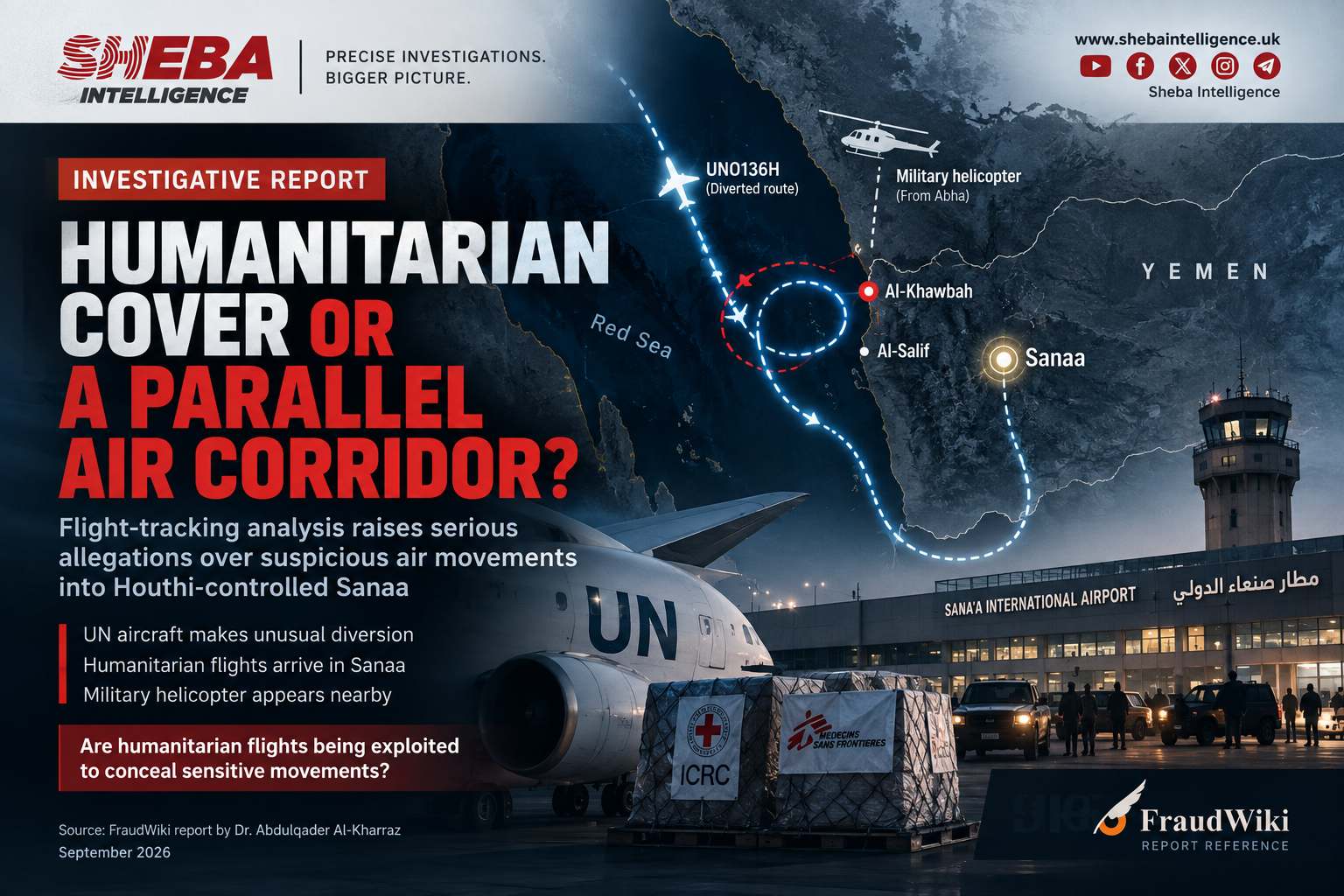
The report, prepared by Dr. Abdulqader Al-Kharraz and published by FraudWiki, examined a series of unusual flight movements on September 16 involving a UN-linked aircraft identified as UNO136H, two humanitarian flights bound for Sanaa, and a military helicopter operating from southern Saudi Arabia.
According to the report, UNO136H departed its normal route over the Red Sea and turned east toward Yemen, penetrating inland in the direction of Al-Khawbah, north of Al-Salif in Hodeidah governorate, before abruptly reversing course and returning west toward the Red Sea.
The aircraft later continued to Aden.
Military Helicopter Appears as UN Aircraft Turns Back
The report highlights the appearance of a military helicopter that had departed from Abha airport in Saudi Arabiaaround the same period.
Al-Kharraz argues that the helicopter's presence may have been connected to UNO136H's sudden reversal and raises the possibility that the aircraft was contacted or challenged before abandoning its eastward movement.
The report, however, provides no independently verifiable evidence of direct communication or interception between the helicopter and UNO136H.
That distinction is significant: the flight-tracking data may document unusual movements, but the circumstances that caused the aircraft to change course remain unclear.
Humanitarian Flights Arrive in Sanaa
More serious allegations emerge from what the report describes as the timing of humanitarian flights into Sanaa.
As UNO136H was making its unusual movement, aircraft operated by the International Committee of the Red Cross and Médecins Sans Frontières (Doctors Without Borders) were approaching Houthi-controlled Sanaa.
The two aircraft reportedly landed at approximately 11:32 a.m. and 11:36 a.m.
The report argues that the convergence of these movements, combined with gaps or irregularities in publicly visible flight-tracking data, warrants scrutiny over whether legitimate humanitarian traffic could be providing a “cover window” for other, less transparent air movements.
It specifically highlights the Djibouti–Sanaa route, describing it as a potential monitoring blind spot because aircraft flying directly to the Houthi-controlled capital may not pass through Aden.
Security Convoys and Ambulances at Sanaa Airport
The report also cites ground observations indicating heightened security activity, convoys and ambulances around Sanaa International Airport before and after the humanitarian aircraft arrived.
According to Al-Kharraz, the activity raises several possibilities, including a medical evacuation involving a senior figure or the movement of foreign personnel.
The report goes further, warning that if a parallel aviation channel exists, it could potentially be exploited for the movement of specialists, senior figures, money or sensitive technical equipment into Houthi-controlled territory.
No evidence presented in the report, however, establishes the identity of any passenger or confirms that experts, officials, weapons-related technology or other sensitive cargo were aboard the humanitarian flights.
These remain allegations and analytical hypotheses rather than independently established facts.
A Previous Incident Involving the Same Aircraft
The September 16 episode may be particularly significant because FraudWiki says it was not the first unusual movement involving UNO136H.
The report links it to an incident on August 24, when the same aircraft was allegedly observed deviating from its declared route and moving deeper into Yemeni airspace.
According to the report, that movement coincided with the arrival of an unidentified aircraft at Sanaa airport.
Al-Kharraz argues that the recurrence involving the same aircraft strengthens the case for examining whether the movements represent isolated aviation anomalies or part of a broader pattern.
Questions Over a ‘Parallel Air Corridor’
Taken together, the flight deviations, overlapping humanitarian arrivals, tracking gaps and unusual ground activity have led the report to raise a politically and security-sensitive question: Is humanitarian aviation into Sanaa being exploited as cover for movements that are not publicly declared?
The report calls for greater transparency surrounding flights into Houthi-controlled Sanaa, including disclosure of flight plans and clearer ADS-B tracking data, as well as closer scrutiny of direct flights between Djibouti and Sanaa.
The allegations are particularly sensitive because humanitarian aviation depends heavily on neutrality and protected access in conflict zones. Any misuse of that framework, if substantiated, could carry consequences extending beyond individual flights and potentially affect confidence in humanitarian operations in Yemen.
However, the report does not establish that the UN, ICRC or MSF knowingly participated in any covert operation, nor does it provide conclusive evidence that humanitarian aircraft transported military personnel or prohibited cargo.
The allegations regarding a “parallel air corridor,” humanitarian cover and the possible movement of experts or sensitive material are conclusions and suspicions raised by the FraudWiki report and have not been independently verified by Sheba Intelligence.