Socotra and Somaliland: Autonomy Narratives Enter the Red Sea Power Game
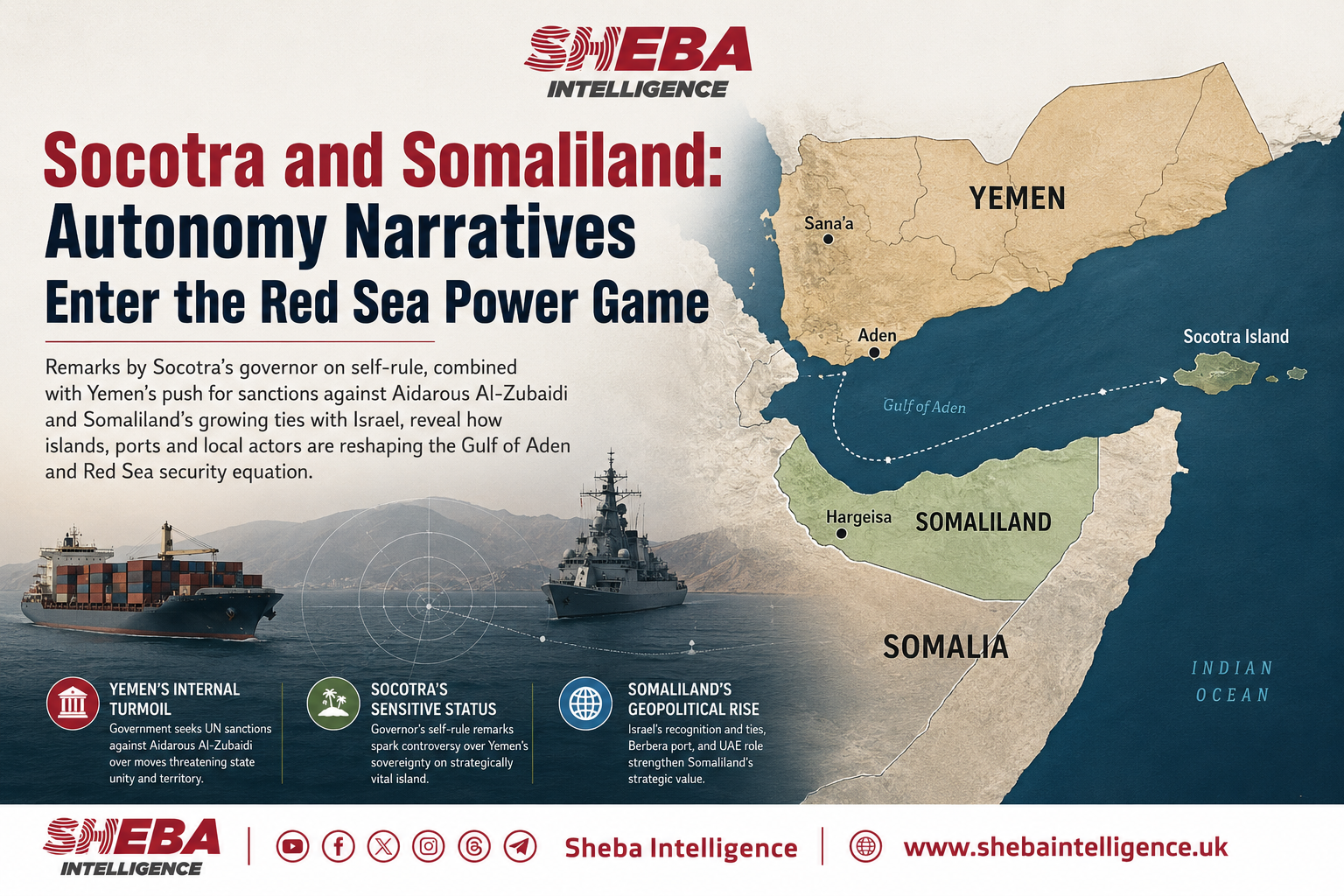
A political controversy in Yemen over the status of Socotra has opened a wider debate about sovereignty, maritime security and the role of regional powers in shaping local authority along the Gulf of Aden and the Red Sea.
The dispute began after Socotra Governor Raafat Al-Thaqali reportedly spoke during an official conference in Aden about the archipelago’s “special status" and its right to self-rule, while questioning what proves Socotra’s Yemeni identity. He also referred to Socotra’s geographic proximity to Somalia compared with mainland Yemen.
The remarks triggered objections from participants, who said Socotra’s status as part of Yemen is established by the constitution, Yemeni law and international recognition. They argued that there is no international dispute over the archipelago’s sovereignty.
But the timing of the remarks has given the issue broader political weight. They came as Yemen’s internationally recognized government asked the UN Security Council to place Aidarous Al-Zubaidi, head of the UAE-backed Southern Transitional Council, on the international sanctions list.
Yemen’s permanent representative to the United Nations, Ambassador Abdullah Ali Fadhel Al-Saadi, accused Al-Zubaidi and other actors of undermining state institutions, imposing unilateral measures by force and threatening Yemen’s unity, sovereignty and territorial integrity.
In its statement to the Security Council, the Yemeni government said recent political and military moves toward eastern Yemen posed a direct threat to the legal standing of the state and to the transitional process. The reference to eastern Yemen is significant because it includes areas linked to Hadramout, Al-Mahra and Socotra — a strategic arc overlooking the Arabian Sea, the Gulf of Aden and the approaches to the Red Sea.
The government also linked Yemen’s internal fragmentation to maritime security, warning that protecting the Red Sea begins with supporting the Yemeni state, not managing the consequences of its weakness.
A Sensitive Maritime Geography
Socotra is not merely a remote Yemeni island. It sits at a sensitive maritime intersection between the Arabian Sea, the Gulf of Aden, the Horn of Africa and the wider Indian Ocean. This geography has long made the archipelago strategically valuable for regional and international actors.
Al-Thaqali’s reference to Socotra’s proximity to Somalia was therefore not received as a simple geographic observation. For critics, it raised concerns that the language of “specificity” and “self-rule” could be used to gradually separate Socotra from Yemen’s national framework, especially at a time when competing regional projects are reshaping control over ports, islands and coastlines.
Legally, there is no equivalence between Socotra and Somaliland. Socotra is internationally recognized as part of Yemen. Somaliland, by contrast, declared separation from Somalia in 1991 and has operated as a self-governing entity for more than three decades.
Yet the comparison is politically relevant because both cases involve maritime geography, local autonomy narratives and the growing interest of outside powers in strategic coastal spaces.
Somaliland’s Rise as a Red Sea Actor
Across the Gulf of Aden, Somaliland has moved from a long-standing unrecognized entity into a more visible player in the Red Sea equation.
Israel formally recognized Somaliland as an independent state in December 2025, becoming the first country to do so. Months later, Somaliland President Abdirahman Mohamed Abdullahi visited Jerusalem, where Somaliland opened an embassy. The move was strongly rejected by Somalia and criticized by several regional and international actors who viewed it as a challenge to Somalia’s sovereignty.
Somaliland’s value lies not only in its political claim to independence, but also in its location along the Gulf of Aden and its control of the port of Berbera. The port has been developed by Dubai-based DP World as part of a major UAE-linked logistics project, placing Berbera within a wider maritime network connecting the Gulf, East Africa, Aden, Djibouti and the Red Sea.
This has turned Somaliland into a potential platform for trade, security and intelligence interests at a time when Houthi attacks from Yemen have increased the strategic importance of every coastal point facing the Red Sea and Gulf of Aden.
UAE, Israel and the Politics of Strategic Local Actors
The UAE appears in this wider equation from two directions: its long-standing relationship with the Southern Transitional Council in Yemen, and its economic and logistical role in Somaliland’s Berbera port.
Israel enters the picture through its recognition of Somaliland and the opening of direct diplomatic ties with Hargeisa. For Israel, Somaliland’s location opposite Yemen has obvious strategic value, especially as the Houthis continue to position themselves as part of the Iranian-led regional front and repeatedly threaten maritime routes linked to Israel and Western interests.
This does not prove that developments in Socotra are directly coordinated with Israel or Somaliland. However, it does show that maritime spaces once treated as peripheral — Socotra, Berbera, Al-Luhiya, Bab Al-Mandab and the Gulf of Aden — are now part of a connected security environment.
In this environment, local authorities, separatist movements and semi-autonomous entities can become valuable partners for regional powers seeking influence without relying solely on recognized central governments.
Yemen’s Fear: Fragmentation Before Sovereignty
For the Yemeni government, the central issue is not only the Southern Transitional Council or Socotra’s local administration. It is the broader risk that Yemen’s weakened state institutions may allow strategic territories to be managed through local or foreign-backed arrangements.
The government’s demand for sanctions against Al-Zubaidi reflects a sharper position toward forces it accuses of weakening the state from within. Its message to the Security Council was clear: maritime security cannot be separated from the restoration of state authority.
This argument comes as Yemen faces two parallel pressures. In the north and west, the Iran-backed Houthis use territory under their control to threaten Red Sea shipping. In the south and east, the government accuses rival forces of imposing unilateral arrangements that undermine sovereignty and complicate the transition process.
Socotra’s controversy has therefore become more than a local debate. It is now part of a wider question: Can Yemen preserve its sovereignty over strategic islands and coastlines while regional powers are building influence across the Red Sea and the Horn of Africa?
Analysis: Similar Tools, Different Legal Cases
The Socotra-Somaliland comparison should be handled carefully. Socotra is not Somaliland, and there is no legal dispute over its Yemeni identity. But the political tools are increasingly familiar: emphasizing local identity, invoking geographic proximity to the Horn of Africa, discussing self-rule, and linking strategic coastal areas to external security and logistics networks.
This pattern is what makes the issue sensitive.
From Somaliland’s recognition by Israel to the UAE’s role in Berbera, and from Yemen’s internal tensions with the Southern Transitional Council to the debate over Socotra’s future, the Gulf of Aden is becoming a laboratory for new forms of influence.
The danger for Yemen is that “autonomy” may begin as an administrative argument but evolve into a geopolitical instrument, especially when applied to islands and ports that sit on vital maritime routes.