Taiz Toxic Shell Reports Renew Scrutiny of Houthi Chemical and Biological Weapons Activities Previously Exposed by Sheba Intelligence
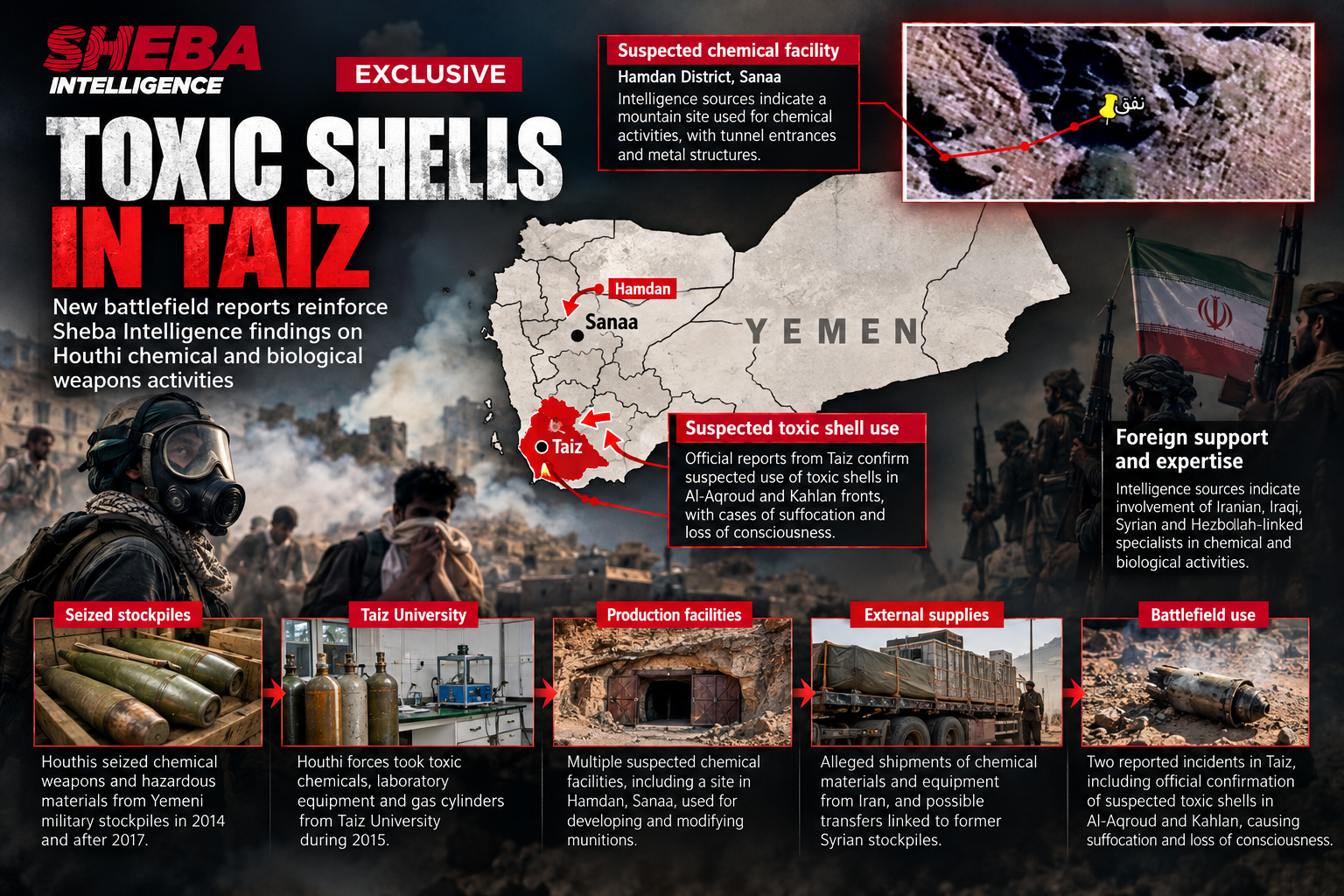
Intelligence documents point to suspected chemical facilities, seized laboratory materials, Iranian-linked technical networks and allegations involving Iraqi, Syrian and Hezbollah specialists, as Yemeni authorities demand an international investigation into suspected toxic munitions.
Sheba Intelligence | Exclusive Investigation
Official reports of suspected toxic munitions used by Houthi forces in Yemen's southwestern Taiz governorate have brought renewed attention to a series of intelligence findings previously published by Sheba Intelligence concerning the group's alleged efforts to develop chemical and biological warfare capabilities.
The latest development marks a significant shift from intelligence warnings about hazardous chemical stockpiles, protective equipment, suspected facilities and possible unconventional weapons transfers to documented official complaints concerning battlefield incidents involving suffocation and loss of consciousness.
On October 28, Taiz's local authorities confirmed receiving reports from several fronts, most recently Al-Aqroud and Kahlan, alleging that Houthi forces had fired shells suspected of containing internationally prohibited toxic substances.
The authorities also acknowledged earlier incidents in which civilians and members of the Popular Resistance reportedly suffered breathing difficulties, with some losing consciousness.
The announcement closely follows earlier Sheba Intelligence investigations into suspected Houthi chemical preparations, the reported transfer of Iranian specialists associated with sensitive military programmes, and discussions between Houthi commanders and Iranian Revolutionary Guard Corps officers concerning possible chemical and biological weapons support.
While the official statement lends new significance to those earlier warnings, it does not independently establish that the Houthis possess or have used chemical weapons. No laboratory findings identifying the suspected substances have yet been made public.
New intelligence material reviewed by Sheba Intelligence also raises questions about chemical materials allegedly seized from Yemeni institutions, suspected facilities in Sanaa governorate, and foreign technical networks potentially involving Iranian, Iraqi, Syrian and Hezbollah-linked personnel.
Additional unverified allegations concern possible transfers of chemical weapons-related stockpiles associated with Syria's former Assad government and Iran's Islamic Revolutionary Guard Corps (IRGC).
Official Taiz Reports Bring Earlier Warnings Back Into Focus
In an official statement published by Yemen's Saba News Agency on October 28, the Taiz local authority said it had received field reports concerning Houthi shells suspected of containing toxic substances.
The latest complaints originated from Al-Aqroud and Kahlan, two areas affected by ongoing fighting in the governorate.
The authority said previous incidents had caused suffocation among civilians and Popular Resistance members, with some victims reportedly losing consciousness.
It called for an urgent technical investigation to establish the nature of the substances involved, document medical cases and witness testimonies, and determine whether internationally prohibited materials had been used.
The authority also urged the United Nations and relevant international bodies to support the investigation and ensure accountability for any confirmed violations.
The reference to earlier incidents is particularly significant.
According to additional field information received by Sheba Intelligence, a suspected gas-related incident occurred approximately one week earlier. Some local witnesses initially believed the substances involved were riot-control agents.
The available information does not establish whether the earlier and more recent incidents involved the same substances.
Nevertheless, the recurrence of these reports raises questions about whether Houthi forces have begun deploying gas-releasing munitions in battlefield operations, a possibility requiring independent technical verification.
Sheba Intelligence Warned of Suspected Chemical Preparations in August
On August 14, Sheba Intelligence published an investigation titled Houthi Chemical Preparedness Raises Concerns.
Intelligence sources told the platform that the Houthis had moved specialised protective, detection, decontamination and containment equipment intended for handling chemical and biological hazards.
The activity reportedly coincided with the accumulation of substantial quantities of dual-use chemicals and the training of technical personnel to handle hazardous materials.
Sources also reported an explosion at a warehouse believed to contain some of these materials and equipment, although the cause remained undetermined.
At the time, Sheba Intelligence emphasised that the reported activities raised concerns about possible unconventional capabilities but did not establish the possession or intended use of chemical or biological weapons.
The October incidents in Taiz now provide a new basis for examining those earlier warnings, particularly the possible relationship between hazardous-material preparations and battlefield activities.
However, no direct link has been established between the previously reported stockpiles and the shells involved in the latest complaints.
Chemical Materials Allegedly Seized From Taiz University
A separate intelligence document reviewed by Sheba Intelligence alleges that Houthi forces acquired hazardous chemical materials and specialised laboratory equipment from Taiz University during the fighting in 2015.
The document refers to the removal of chemical compounds and laboratory equipment, including a specialised apparatus used for separating and extracting substances.
Additional information provided to the platform alleges that the Houthis also removed cylinders containing toxic gases from university facilities.
If verified, these allegations could help explain one potential domestic source of chemical materials available to the group.
However, Sheba Intelligence has not obtained inventory records, transport documentation or independently verified testimony establishing the precise contents of the cylinders, their destination or their subsequent use.
There is currently no evidence connecting the alleged university materials to the suspected toxic shells reported in Taiz in October 2026.
Former Yemeni Military Stockpiles
The intelligence document also alleges that the Houthis seized hazardous military materials after taking control of Sanaa and state military facilities in September 2014.
Additional stockpiles were reportedly acquired following the killing of former President Ali Abdullah Saleh in December 2017.
According to the document, some of the materials included incendiary munitions and older chemical stocks allegedly held by Yemen's former armed forces.
The document further claims that certain chemical materials originated from military arrangements between Yemen and Iraq during the presidencies of Saleh and Saddam Hussein.
It alleges that the Houthis subsequently relocated some of these materials to storage facilities across areas under their control.
These historical claims remain unverified. No official transfer records or independently authenticated military inventories have been obtained to substantiate them.
Taken together, the allegations suggest that any investigation into possible Houthi chemical capabilities should examine both external procurement networks and hazardous materials inherited or seized from domestic institutions.
Suspected Chemical Facilities in Sanaa Governorate
As part of its investigation, Sheba Intelligence obtained an image and source information concerning a mountainous site in Hamdan district, Sanaa governorate.
The source alleges that the location is associated with chemical-related military activities and forms part of a wider network of facilities operated by the Houthis.
The image shows rocky terrain and dark openings, including one marked as a tunnel.
The source also described metal structures near the entrance and claimed that the location is one of several facilities linked to the group's suspected chemical activities.
Sheba Intelligence has not independently established the site's function or confirmed the presence of chemical weapons production equipment.
The image alone cannot demonstrate that the facility manufactures chemical agents or chemical munitions.
The platform is withholding precise geographical details while continuing to assess the information and its implications for civilian safety.
Iran's Reported Role in Sensitive Military Programmes
Iran features prominently in several intelligence reports obtained by Sheba Intelligence concerning the transfer of specialists, military equipment and technical expertise to Houthi-controlled Yemen.
On August 26, the platform published Iran Moved Experts Linked to Sensitive Programmes to Yemen, Sources Say.
The investigation reported that Iranian specialists associated with sensitive military programmes, including biological fields, had allegedly reached Houthi-controlled territory through multiple routes.
The sources did not establish the specialists' precise assignments or whether they were involved in developing prohibited weapons.
The investigation also examined possible movements of specialised equipment alongside personnel transfers, while acknowledging that the contents of the alleged shipments remained unverified.
A subsequent Sheba Intelligence investigation published on October 6 provided another significant development.
In Houthi-Iranian Military Meeting in Sanaa Discusses ‘Dawn of Yemen’ Fallout and Urgent Iranian Support, sources described a closed-door meeting attended by senior Houthi commanders and IRGC liaison officers.
According to the report, the meeting addressed military developments following the launch of the Yemeni government's Dawn of Yemen offensive.
The discussions reportedly included potential Iranian assistance involving chemical bombs and biological weapons, particularly amid concerns over possible government advances toward Hodeidah and Saada.
The information did not establish that such weapons were delivered or that any proposed transfer was implemented.
The latest reports from Taiz nevertheless raise the importance of determining whether the alleged discussions were followed by actual changes in the group's military capabilities.
Iraqi, Syrian and Hezbollah-Linked Specialists
Additional intelligence leads under examination by Sheba Intelligence concern the alleged involvement of foreign specialists from Iraq and Syria, as well as individuals linked to Lebanon's Hezbollah.
The allegations suggest that some personnel may have experience in sensitive military or chemical-related fields.
The intelligence document reviewed by the platform refers more generally to Iranian advisers and specialists from other Arab countries allegedly involved in Houthi military development activities.
However, the document does not independently identify Iraqi or Syrian specialists or establish their involvement in a chemical weapons programme.
The more specific allegations concerning their nationalities and possible Hezbollah connections come from separate, unverified intelligence leads.
Sheba Intelligence has not independently established the identities, professional backgrounds, locations or operational assignments of the individuals concerned.
Their reported presence, even if confirmed, would not by itself establish participation in prohibited weapons activities.
The allegations nevertheless warrant further scrutiny of possible transfers of specialised military expertise through regional networks associated with Iran.
Allegations Involving Syria's Former Chemical Weapons Stockpiles
Another sensitive line of inquiry concerns allegations that chemical weapons-related materials associated with former Syrian President Bashar al-Assad's military programme may have been transferred through networks connected to Iran and its regional allies.
Some of the information under review raises the possibility that materials or equipment originating from former Syrian stockpiles could have reached Houthi-controlled territory.
The allegations also refer to possible transfers involving IRGC-associated stocks or equipment.
Syria's former chemical weapons programme has been the subject of extensive international investigations, including inquiries by the Organisation for the Prohibition of Chemical Weapons (OPCW).
The existence of undeclared chemical materials and unresolved questions surrounding the former Syrian programme, however, does not establish that any stockpiles were transferred to Yemen.
Sheba Intelligence has not obtained authenticated shipping records, transfer documents, laboratory findings or independently verified witness accounts linking specific Syrian chemical materials to the Houthis.
The alleged Syrian connection therefore remains an unconfirmed intelligence lead rather than an established supply route.
Biological Activities: A Separate but Related Concern
The intelligence concerns surrounding the Houthis extend beyond chemical materials.
Previous Sheba Intelligence reporting described the alleged arrival of specialists with backgrounds in biological programmes, as well as equipment designed for protection against chemical and biological hazards.
The October 6 report also referred to biological weapons among the potential forms of Iranian support reportedly discussed by Houthi and IRGC representatives.
These findings raise questions about whether the group is seeking broader unconventional capabilities alongside its established missile and drone programmes.
However, there is no independently verified evidence that the Houthis possess biological weapons, have developed biological agents for hostile use, or operate facilities dedicated to producing such weapons.
Protective equipment and biological expertise can also serve legitimate medical, industrial and research purposes.
The biological dimension therefore requires a separate evidentiary assessment and should not be treated as established by the suspected chemical incidents in Taiz.
Could Riot-Control Agents Have Been Used in Combat?
One important aspect of the latest reports is the initial description of the earlier Taiz incident as possibly involving riot-control gases.
Such substances can cause severe irritation of the eyes and respiratory system, but their properties differ from those of other chemical warfare agents.
Under the Chemical Weapons Convention, the use of riot-control agents as a method of warfare is prohibited.
Determining whether the reported incidents constitute prohibited chemical weapons use will require evidence concerning the substances involved, the munitions used and the circumstances of their deployment.
Medical records, witness testimony, environmental and munition samples, and independently conducted laboratory analysis will be essential.
Symptoms alone cannot establish the identity of a chemical agent or prove deliberate chemical weapons use.
From Intelligence Warnings to International Investigation
The emerging picture involves several distinct but potentially connected lines of inquiry: suspected hazardous-material stockpiles, allegations of chemical-related facilities, reported foreign technical assistance, and recent battlefield complaints involving toxic exposure symptoms.
The Taiz local authority's announcement provides an official basis for examining the latest incidents and their possible relationship to earlier intelligence findings.
But establishing an operational connection between these elements will require evidence identifying the substances used, their sources, and the individuals or organisations responsible for their production, transfer or deployment.
If an independent investigation confirms that toxic chemicals were deliberately used as weapons, the findings could have serious consequences under international humanitarian law and the Chemical Weapons Convention.
Evidence of foreign involvement in the supply or development of prohibited weapons would raise additional questions about regional proliferation networks and accountability.
Conclusion
The October 28 statement by Taiz authorities has brought renewed significance to intelligence warnings published by Sheba Intelligence since August concerning suspected Houthi chemical and biological weapons-related activities.
The platform's reporting has identified several areas requiring further investigation, including hazardous materials allegedly seized from Yemeni institutions, suspected facilities in Sanaa governorate, Iranian-linked technical networks, and unverified allegations involving Iraqi, Syrian and Hezbollah-associated specialists.
Claims about possible transfers of chemical weapons-related materials from Syria's former Assad government and Iranian military networks remain particularly sensitive and have not been independently substantiated.
The central question is now whether the suspected toxic munitions reported in Taiz can be scientifically identified and traced to a specific source.
Until such evidence becomes available, the reported incidents and intelligence findings remain grounds for investigation rather than conclusive proof of a Houthi chemical or biological weapons programme.
Sheba Intelligence continues to examine these allegations and the possible connections between foreign assistance, domestic stockpiles, suspected facilities and battlefield incidents in Yemen.