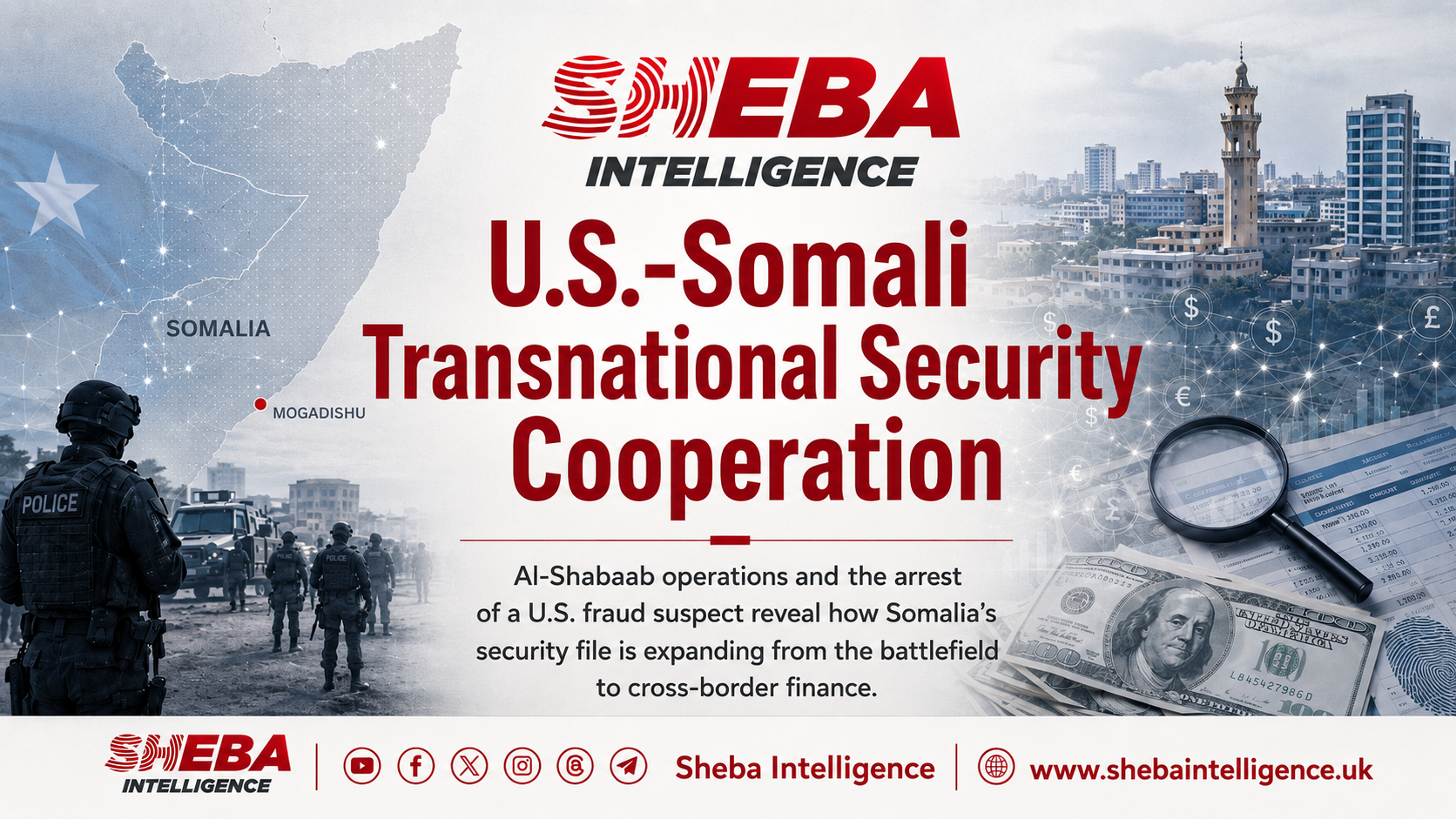
Recent developments in Somalia have placed the country at the center of two overlapping security tracks: continued military pressure on Al-Shabaab and expanding U.S.-Somali cooperation in pursuing transnational fraud and money-laundering suspects.
Somali forces, backed by international partners, have carried out fresh operations against Al-Shabaab in central Somalia, including Middle Shabelle and Hiran, killing dozens of militants in recent raids. The operations form part of a wider campaign to weaken the group’s mobility around strategic rural corridors, farming zones and routes used for recruitment, taxation, extortion and movement toward Mogadishu.
At the same time, U.S. authorities announced the arrest in Mogadishu of Abdikerm Abdelahi Eidleh, a Somali-born American from Minnesota, over his alleged role in the Feeding Our Future fraud case, one of the largest pandemic-era fraud schemes involving U.S. federal child nutrition funds.
According to the U.S. Department of Justice, Eidleh faces 31 charges, including wire fraud, bribery and money laundering. U.S. authorities say he allegedly helped move millions of dollars through shell companies and fraudulent transactions linked to the wider scheme. His arrest was carried out with the support of Somali authorities, including Somalia’s National Intelligence and Security Agency.
The case is not officially linked to Al-Shabaab. Available U.S. statements do not accuse Eidleh of financing the group. However, the arrest in Mogadishu highlights the sensitivity of financial routes between the United States and the Horn of Africa at a time when Somalia remains exposed to weak financial oversight, informal transfer systems, shell companies and cross-border money flows.
For Somalia, the timing is significant. While security forces are pursuing Al-Shabaab militarily, U.S. and Somali agencies are also moving against financial crime networks that can exploit fragile institutions, diaspora links and transnational business channels. This widens the definition of security in Somalia from battlefield operations to financial tracking, legal cooperation and the pursuit of fugitives.
Sheba Intelligence has previously reported on how Somalia and Somaliland are becoming increasingly important in Red Sea and Horn of Africa security calculations, including concerns over militant networks, smuggling routes, foreign-linked training activity and the use of weakly governed spaces by armed and illicit actors. The latest developments reinforce that Somalia’s security challenge is no longer limited to Al-Shabaab’s armed operations, but also includes the financial and logistical systems that may operate around fragile state structures.
The arrest also shows a growing role for Mogadishu as a partner in law-enforcement operations beyond counterterrorism. For Washington, Somalia is not only a front in the campaign against Al-Shabaab, but also a jurisdiction where fugitives, illicit finance suspects and cross-border networks may be located and pursued.
This dual pressure — military operations against Al-Shabaab and financial-crime enforcement linked to U.S. investigations — points to a broader security shift. Somalia is being treated not only as a battlefield against an armed group, but as a strategic space where counterterrorism, financial oversight and international law enforcement increasingly intersect.