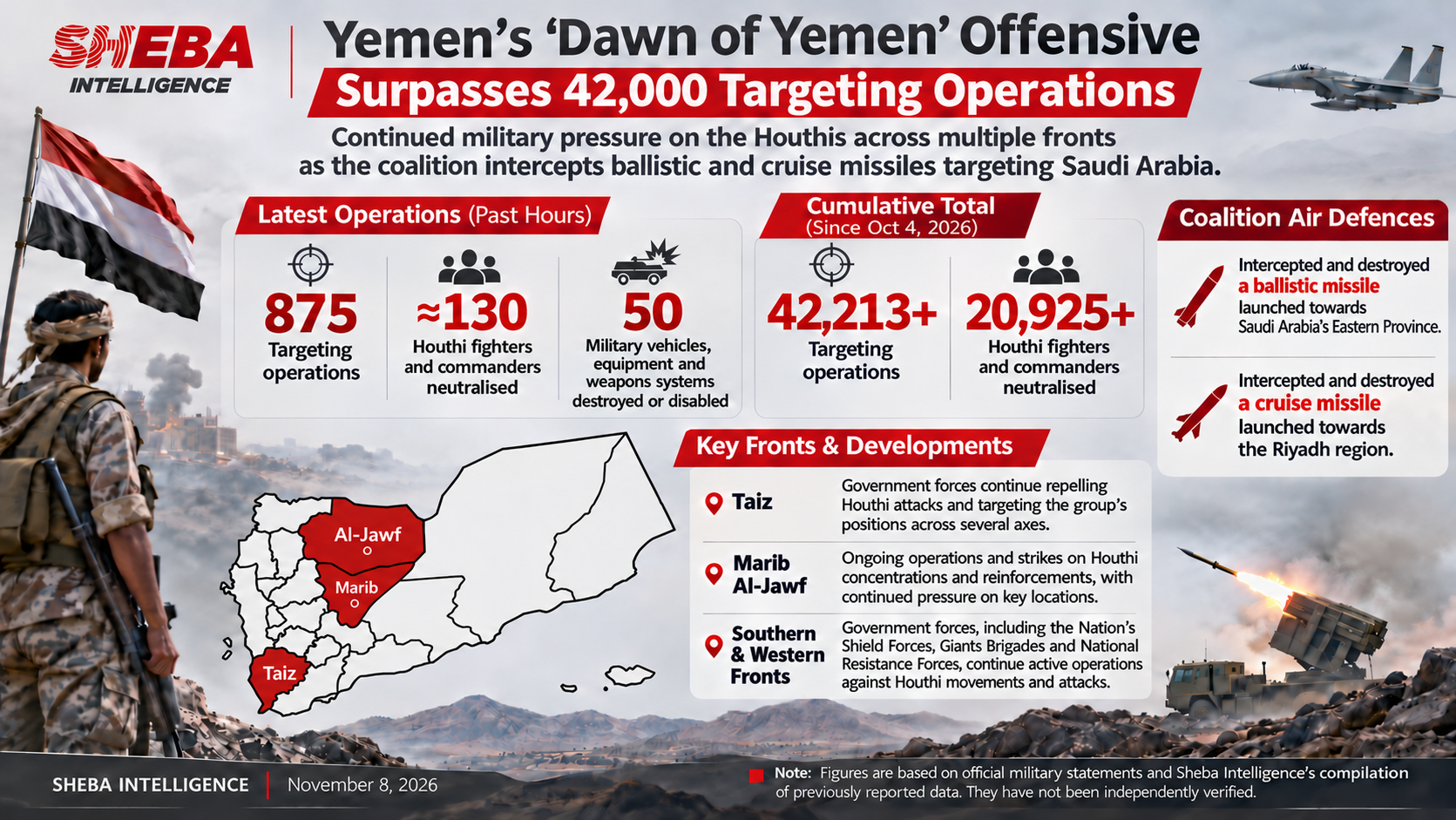
Yemen’s ‘Dawn of Yemen’ Offensive Surpasses 43,000 Targeting Operations as Coalition Destroys Houthi Missile Launchers in Saada
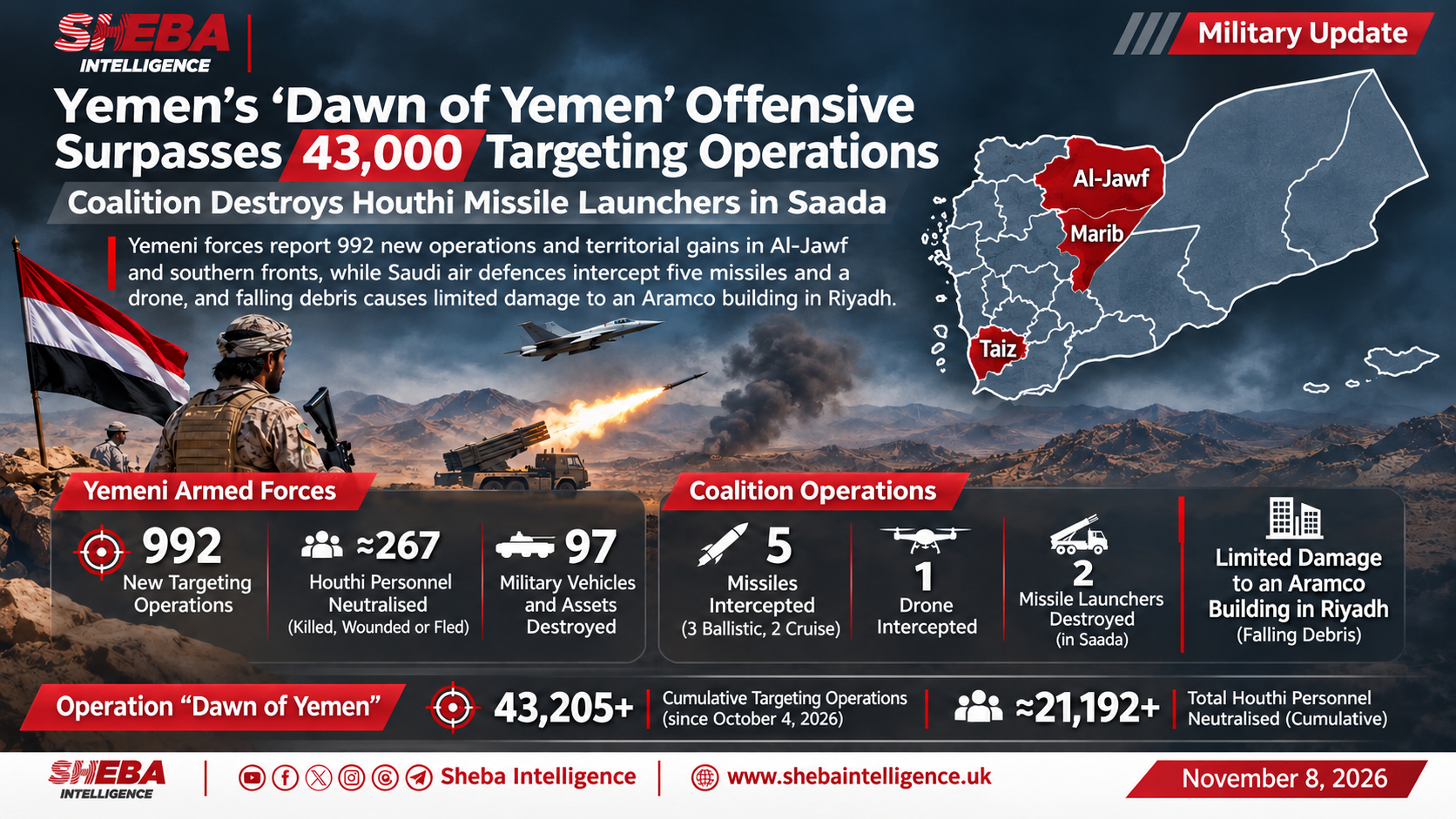
Yemeni forces report 992 new targeting operations and territorial gains in Al-Jawf and southern Yemen, while Saudi air defences intercept five missiles and a drone and falling debris causes limited damage to an Aramco building in Riyadh.
Yemeni government forces have continued their military campaign under Operation Dawn of Yemen, reporting fresh territorial gains in Al-Jawf and southern Yemen as the cumulative number of targeting operations provisionally surpassed 43,000 since the offensive began on October 4.
The latest developments coincide with continued Houthi missile and drone attacks against Saudi Arabia, prompting a series of interceptions by coalition air defences and the destruction of two ballistic missile launchers in Yemen’s northern Saada governorate.
According to official Saudi announcements, air defence systems intercepted and destroyed five missiles and one unmanned aerial vehicle targeting several regions of the Kingdom, including Riyadh.
The Saudi Ministry of Energy also confirmed that falling debris caused limited material damage to an administrative building belonging to Saudi Aramco in Riyadh, without injuries or fatalities.
Meanwhile, the Yemeni Armed Forces announced 992 new targeting operations against Houthi positions, troop concentrations, reinforcements and military equipment across several battlefronts.
Initial military assessments indicated that approximately 267 Houthi fighters and commanders were neutralised, including personnel reported killed, wounded or forced to flee the battlefield, while 97 military vehicles, weapons systems and other combat assets were destroyed or disabled.
The battlefield figures remain preliminary and have not been independently verified.
Coalition Intercepts Five Missiles and a Drone, Destroys Launchers in Saada
The Saudi-led coalition announced that its air defence systems had intercepted and destroyed two ballistic missiles launched by the Houthis towards Riyadh, along with another ballistic missile targeting Saudi Arabia’s Eastern Province.
The coalition also reported intercepting two cruise missiles directed towards the Riyadh and Southern regions, in addition to an unmanned aerial vehicle launched towards southern Saudi Arabia.
The announcements brought the reported number of intercepted missiles to five, comprising three ballistic missiles and two cruise missiles, alongside one drone.
In a subsequent statement, the coalition announced the destruction of two ballistic missile launchers in Saada governorate.
According to the coalition, the Houthis had used the two launchers in an attempted missile attack against Riyadh earlier the same day.
The announcement marked a further development in the coalition’s response to Houthi cross-border attacks, extending its operations beyond the interception of incoming missiles to strikes against launch systems inside Yemen.
The coalition did not disclose additional details about the precise locations of the launchers or the weapons used to destroy them.
The destruction of two launchers does not, however, establish the overall extent of damage to the Houthis’ remaining missile capabilities.
Saudi Energy Ministry Confirms Limited Damage to Aramco Building in Riyadh
Saudi Arabia’s Ministry of Energy confirmed that an administrative building belonging to Saudi Aramco in Riyadh sustained limited material damage as a result of falling debris during the attempted attacks against the capital.
According to the ministry’s statement, the incident caused no injuries or fatalities.
The announcement came amid a series of Houthi missile launches towards Saudi territory, several of which were intercepted and destroyed by coalition air defence systems.
The official Saudi account confirmed the limited damage to the building but did not identify which intercepted projectile was responsible for the debris.
The incident highlights the continuing risks associated with missile attacks, including the potential for falling debris to damage civilian and economic infrastructure even when incoming projectiles are intercepted.
Yemeni Forces Conduct 992 New Targeting Operations
On Yemen’s internal battlefronts, the Yemeni Armed Forces announced 992 targeting operations involving fighter aircraft, unmanned aerial vehicles, field artillery and multiple-launch rocket systems.
According to the military statement, fighter aircraft conducted 19 airstrikes against Houthi positions, troop concentrations and military vehicles in Marib, Taiz and Tor Al-Bahah.
Unmanned aerial vehicles carried out another 29 targeting sorties against combat positions, weapons and military equipment.
Meanwhile, field artillery and multiple-launch rocket systems conducted 944 targeting operations against Houthi reinforcements, defensive fortifications, sniper positions and artillery emplacements.
Initial battlefield assessments indicated that approximately 267 Houthi fighters and commanders were neutralised, including those killed, wounded or forced to flee the fighting.
The military also reported destroying or disabling 97 vehicles, artillery pieces, missile launchers and other military assets, alongside several fortified positions and firing sites.
The Yemeni Armed Forces said battlefield monitoring and verification were continuing to establish the full extent of the losses.
Government Forces Report New Advances in Al-Jawf
In Al-Jawf governorate, government forces reported fresh territorial gains while continuing mine-clearance operations in areas recovered during previous fighting.
Units from the Emergency Forces and Nation’s Shield Forces maintained operations against Houthi positions and movements along the northern front.
The latest developments follow earlier reported advances around Umm Lafifah, Qurun Al-Sabir and Duhaydat Al-Aqir, as well as positions along the Duhayda and Huwayshan mountain ranges.
These areas hold military significance because of their proximity to routes leading towards Al-Hazm, the capital of Al-Jawf governorate, and the importance of elevated terrain in securing military movements and supply lines.
The latest military statement did not identify all newly captured positions or provide independently verifiable measurements of the territory brought under government control.
Fighting Continues in Marib, Taiz and Southern Yemen
In Marib, units from the Third, Sixth and Seventh Military Regions continued operations against Houthi positions and reinforcements across several sectors.
In Taiz, government forces supported by Popular Resistance units reported repelling Houthi attacks and targeting the group’s movements, troop concentrations and firing positions.
Along the southern and southwestern fronts, Nation’s Shield Forces, Giants Brigades and National Resistance Forces continued their military operations.
The Yemeni military announced that government-aligned units had captured additional positions in several sectors, while fighting continued elsewhere.
The developments indicate that ground operations remain active alongside sustained aerial and artillery strikes, with government forces seeking to secure previously recovered positions and maintain pressure across multiple fronts.
Cumulative Targeting Operations Exceed 43,200
A review of successive Yemeni military statements compiled by Sheba Intelligence indicates that the cumulative number of targeting operations conducted under Operation Dawn of Yemen has provisionally reached at least 43,205 since October 4, 2026.
The previous cumulative figure stood at 42,213 operations before the latest announcement of 992 additional targeting operations.
Adding the latest figures brings the cumulative total above 43,200, provided the reporting periods do not overlap.
The corresponding cumulative number of Houthi personnel reported neutralised has provisionally risen to more than 21,192, based on the same reporting sequence.
These figures remain preliminary and have not been independently verified.
The military term neutralised includes personnel reported killed, wounded or forced to flee the battlefield and should not be interpreted as a confirmed death toll.
Similarly, the cumulative targeting figure includes different forms of military activity, such as airstrikes, drone sorties and artillery fire, rather than exclusively individual airstrikes.
Missile Escalation Coincides with Continued Ground Operations
The latest developments highlight two simultaneous dimensions of the military confrontation: sustained government operations against Houthi positions inside Yemen and coalition efforts to counter missile and drone attacks against Saudi Arabia.
The coalition’s announcement that it destroyed two ballistic missile launchers in Saada indicates that its response includes strikes against launch infrastructure as well as the interception of incoming projectiles.
Meanwhile, the continued launch of ballistic missiles, cruise missiles and drones towards Saudi territory indicates that the Houthis retain some long-range strike capabilities despite sustained military operations against their positions.
On the ground, the latest government statements point to continued efforts to recover and consolidate territory in Al-Jawf and southern Yemen, alongside ongoing fighting in Marib and Taiz.
The military significance of these developments will depend on the durability of territorial gains, the security of recovered positions and the extent to which Houthi missile and military capabilities can be disrupted.
The cumulative targeting figures are based on Yemeni military statements compiled by Sheba Intelligence and remain subject to further verification.