
Houthi Blockade Accelerates Saudi Arabia’s Regional Security Strategy
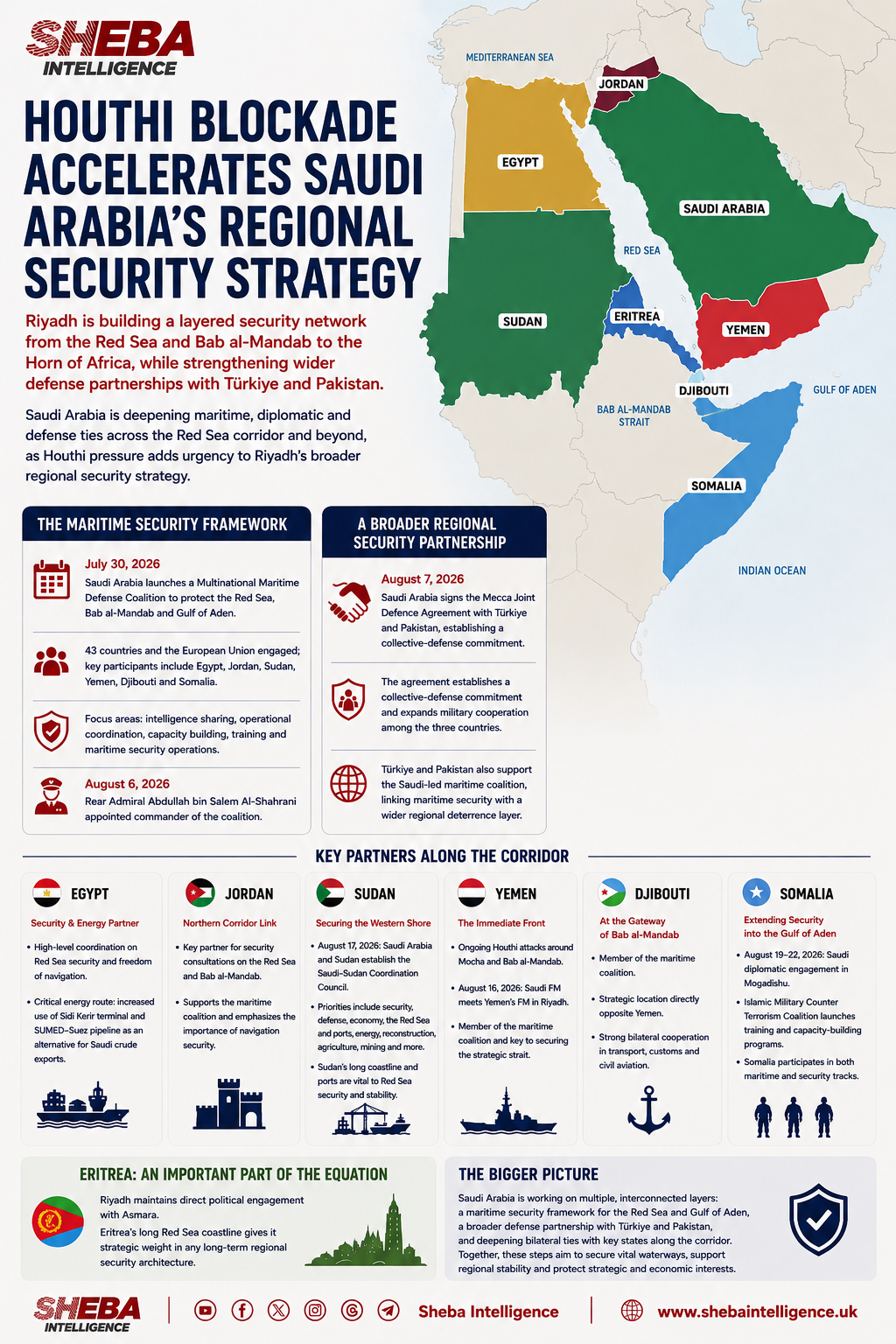
Saudi Arabia is deepening maritime, diplomatic and defense ties from Egypt and Sudan to Yemen and the Horn of Africa, as Houthi pressure adds urgency to Riyadh’s broader regional security strategy.
Saudi Arabia has stepped up diplomatic and security activity along the Red Sea since the Houthis resumed maritime attacks and declared a blockade targeting Saudi-linked shipping on July 20.
Riyadh's response has moved on several tracks. It launched a multinational maritime defense initiative covering the Red Sea, Bab al-Mandab and Gulf of Aden, strengthened coordination with key littoral states, and expanded security engagement with Somalia. At the same time, its new defense partnership with Türkiye and Pakistan has added a wider regional layer to these arrangements.
The activity comes as the Houthis increase pressure around Yemen's western coast and Bab al-Mandab, extending a maritime campaign that has gradually moved from Israel-linked shipping to US- and UK-linked vessels and, most recently, Saudi interests.
The Maritime Response
The July 20 Houthi blockade marked a significant shift. Hours before the announcement, Sheba Intelligence had reported indications that the group was preparing a new phase of escalation.
Sheba Intelligence later reported that a Houthi maritime operations center in Sanaa was administering restrictions on Saudi-linked shipping through lists of vessels and companies, warnings, and requests for what the group calls "safe passage." Other Sheba Intelligence reporting tracked missile, drone and naval preparations along Yemen's western coast and around Bab al-Mandab.
Ten days after the blockade announcement, Saudi Arabia hosted military representatives from 43 countries and the European Union to establish a Multinational Maritime Defense Coalition for the Red Sea, Bab al-Mandab and Gulf of Aden.
The initiative brought together states along the maritime corridor, including Egypt, Jordan, Sudan, Yemen, Djibouti and Somalia, alongside other regional partners. Its proposed areas of cooperation include intelligence sharing, operational planning, training and maritime coordination.
Saudi Rear Admiral Abdullah bin Salem Al-Shahrani was appointed commander on August 6, giving the initiative an organized military structure.
The maritime framework is also part of a wider Saudi effort to strengthen regional defense partnerships. On August 7, Saudi Arabia signed the Mecca Joint Defence Agreement with Türkiye and Pakistan, establishing a collective-defense commitment and expanding military cooperation between the three countries.
Türkiye and Pakistan also support the Saudi maritime initiative. The two frameworks remain separate, but their membership overlaps and both have emerged amid Riyadh's broader effort to strengthen regional deterrence and protect strategic waterways.
Egypt: Maritime Security and Energy
Egypt has become a central partner in this effort.
Saudi Foreign Minister Prince Faisal bin Farhan discussed Red Sea and Gulf waterway security and freedom of navigation with Turkish Foreign Minister Hakan Fidan on August 11. Three days later, he travelled to Egypt for talks in El Alamein with Egyptian Foreign Minister Badr Abdelatty and Fidan.
Egypt's importance is not limited to diplomacy. As Houthi threats complicated Saudi exports through the southern Red Sea, Saudi Aramco increased its use of Egypt's Sidi Kerir terminal and the SUMED-Suez route, providing an alternative channel for crude shipments affected by risks around Bab al-Mandab.
Cairo therefore provides Riyadh with both a security partner at the northern end of the Red Sea and infrastructure that can reduce exposure to disruptions farther south.
Yemen: Pressure at Bab al-Mandab
Yemen remains the immediate front.
On August 16, Faisal bin Farhan received Yemeni Foreign Minister Afrah Al-Zouba in Riyadh for talks on developments in Yemen and the region.
The meeting came amid a sharp escalation on the western coast. Sheba Intelligence documented repeated Houthi missile and drone attacks on Mocha between August 9 and 14, alongside attacks and threats affecting commercial navigation around Bab al-Mandab.
Earlier Sheba Intelligence reporting had also tracked Houthi military preparations along the western coast and plans for operations linked to Bab al-Mandab.
The concentration of attacks around Mocha gives the Yemeni government's participation in the Saudi maritime initiative particular importance. The area sits close to the strait and remains one of the main government-held positions on Yemen's Red Sea coast.
Sudan: A Broader Partnership on the Western Shore
Saudi engagement with Sudan has also moved beyond routine diplomacy.
On August 17, Faisal bin Farhan received Sudanese Foreign Minister Mohieldin Salem Ahmed Ibrahim in Riyadh. The two sides held political consultations and signed the document establishing the Saudi-Sudanese Coordination Council.
The framework covers a broad range of issues, including the Red Sea and ports, energy, reconstruction, agriculture and mining, while Sudanese officials identified security, defense and economic cooperation among its priorities.
Sudan is also part of the Saudi maritime initiative and has publicly condemned Houthi threats against Saudi Arabia and freedom of navigation.
Its position matters to Riyadh. Sudan has a long coastline facing Saudi Arabia, while its ports connect the Red Sea to the Horn of Africa and the wider African interior. The new coordination council gives this relationship an institutional framework extending beyond immediate maritime threats.
The Horn of Africa: Djibouti and Somalia
On the southern African shore, Saudi activity is most visible in Djibouti and Somalia.
Djibouti has joined the maritime initiative, placing a state directly opposite Yemen at Bab al-Mandab within the Saudi-backed framework. Riyadh has also developed bilateral cooperation with Djibouti in transport, customs and civil aviation, alongside regular political contacts.
In Somalia, Saudi engagement has moved further into the security field.
On August 19, Saudi Ambassador Ahmed Mohammed Almowallad met senior Somali officials in Mogadishu as Riyadh continued its engagement with federal institutions.
Two days later, Maj. Gen. Mohammed bin Saeed Al-Moghedi, secretary-general of the Saudi-based Islamic Military Counter Terrorism Coalition, arrived in Mogadishu. The coalition subsequently began implementing counterterrorism, training, strategic communications and capacity-building programs with Somali institutions.
The counterterrorism coalition is separate from the new maritime initiative, but Somalia participates in both tracks. Saudi-Somali defense cooperation had already expanded earlier this year with the signing of a military cooperation agreement.
The activity comes as piracy has again become a concern in waters between Somalia and Yemen, adding to the security challenges around the Gulf of Aden.
Eritrea, with its long Red Sea coastline, remains important to the wider picture. Riyadh maintains direct political contacts with Asmara, including engagement with President Isaias Afwerki, although its position in the emerging maritime arrangements is less defined than that of Djibouti and Somalia.
A Wider Saudi Security Approach
The Saudi moves do not amount to a single alliance or command structure. They involve different mechanisms: a maritime coalition, the Saudi-Türkiye-Pakistan defense partnership, bilateral diplomacy and security programs with individual states.
What connects them is geography and timing.
Egypt and Sudan cover key sections of the northern and western Red Sea; Yemen and Djibouti sit on opposite sides of Bab al-Mandab; Somalia extends the security environment into the Gulf of Aden. Saudi Arabia is strengthening ties across each of these areas as Houthi pressure moves beyond Yemen into the surrounding waterways.
The Houthi blockade did not create Saudi Arabia's regional security strategy, but it appears to have accelerated its maritime dimension.
For now, the most important question is whether these diplomatic and defense arrangements move further into intelligence sharing, naval coordination and practical cooperation among Red Sea littoral states.
If they do, Riyadh's response will be broader than containing Houthi attacks: it will be part of a developing Saudi approach to securing the Red Sea and Bab al-Mandab through a network of regional partners.