Turkish F-16 Strikes in Somalia Put Al-Shabaab Under New Pressure
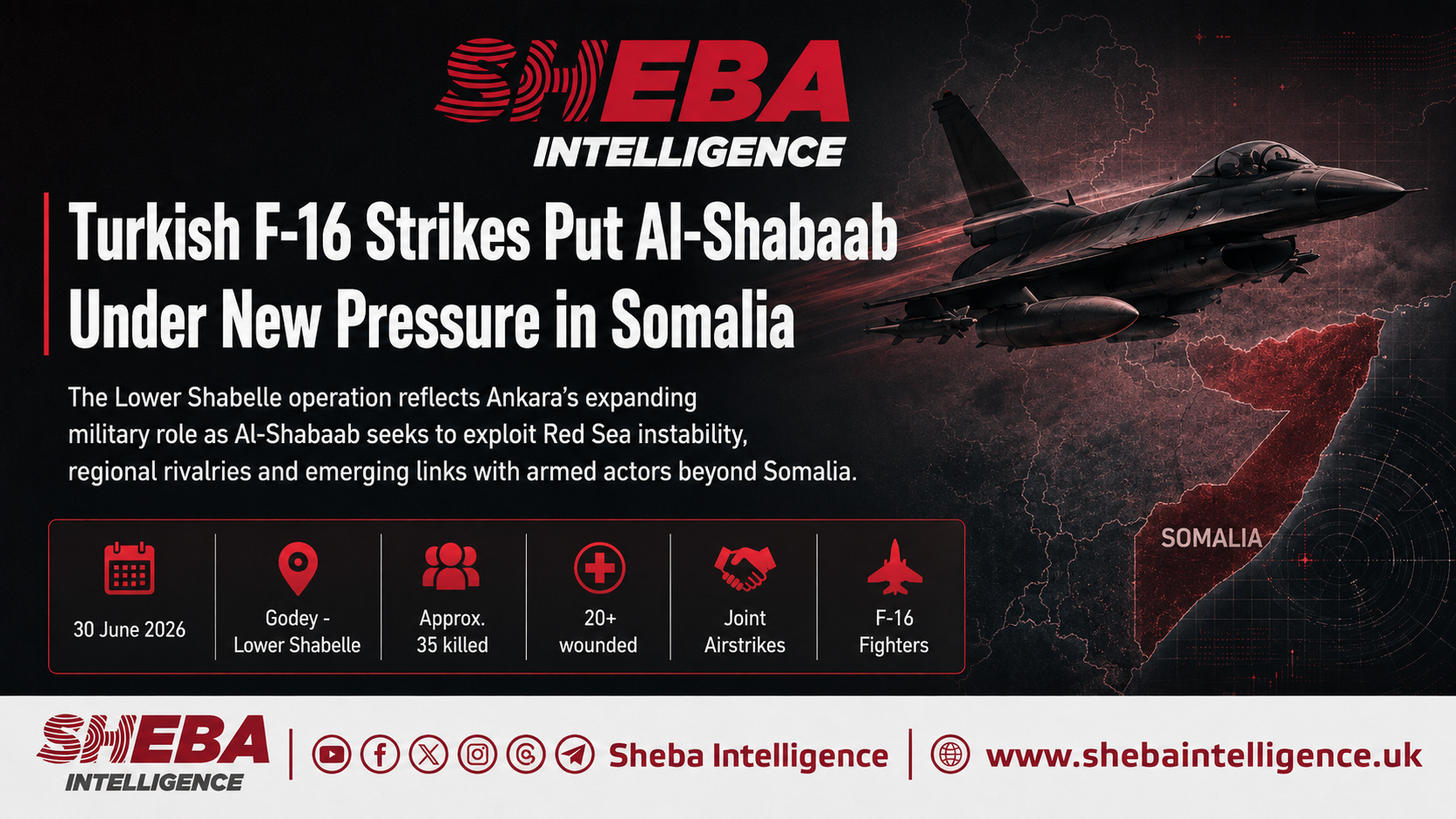
The Lower Shabelle operation reflects a more active Turkish role in Somalia’s counterterrorism campaign, as Al-Shabaab seeks to adapt to regional rivalries, Red Sea instability and emerging links with armed actors beyond Somalia.
Somalia’s Ministry of Defence said on Tuesday, June 30, 2026, that the Somali National Armed Forces, in cooperation with the Turkish Armed Forces, carried out airstrikes against Al-Shabaab positions in the Godey area of Lower Shabelle region.
According to the ministry’s statement, the operation used F-16 fighter aircraft to target caves, weapons depots, hideouts and staging areas used by the group. The ministry said about 35 Al-Shabaab fighters were killed and more than 20 others were seriously wounded. It also reported secondary explosions after the strikes, suggesting that ammunition, explosive materials or weapons stockpiles were present at the targeted location.
The use of F-16s is the most important detail in the announcement. In April 2026, Turkey’s deployment of F-16 multirole fighter aircraft to Somalia became publicly visible when Turkish jets flew over Mogadishu during celebrations marking the 66th anniversary of the Somali National Armed Forces. The latest operation therefore appears to move the Turkish role from training and capacity-building into a more direct operational role in Somalia’s war against Al-Shabaab.
Turkish-Somali Cooperation: From Training to Combat Support
Turkey’s security relationship with Somalia has developed gradually over more than a decade. Ankara first built its influence through humanitarian support, infrastructure projects and state-building assistance, before expanding into military training and security cooperation.
The main symbol of this partnership is Camp TURKSOM in Mogadishu, Turkey’s major overseas military training facility. Since its opening in 2017, the facility has served as a central hub for training Somali officers, non-commissioned officers and military units linked to the rebuilding of the Somali National Armed Forces.
This cooperation deepened in February 2024, when Turkey and Somalia signed a defence and economic cooperation agreement. The agreement expanded Ankara’s role in Somali security, including maritime security and support for Somalia’s ability to protect its territorial waters. That file later became connected to Turkey’s wider economic and energy interests in Somalia’s maritime zone.
This is why the latest airstrikes are not an isolated military event. They fit into a broader Turkish-Somali partnership that has moved through three stages: training Somali forces, supporting Somali maritime security, and now providing advanced airpower in counterterrorism operations.
For Mogadishu, this gives the federal government access to a partner that is already deeply embedded in the Somali security structure. For Ankara, the operation shows that Somalia has become one of Turkey’s most important security partnerships in Africa and the western Indian Ocean.
Lower Shabelle: A Pressure Belt Around Mogadishu
The choice of Lower Shabelle is also significant. The region lies close to Mogadishu and has long served as one of Al-Shabaab’s most important operational corridors. The group has used parts of the region for movement, logistics, explosives preparation and attacks against government areas.
The Somali Defence Ministry said the Godey site contained hideouts, weapons depots and vehicles loaded with explosive materials. If accurate, this means the strike was not only aimed at killing fighters, but also at disrupting a possible attack chain before it reached Mogadishu or other civilian and government targets.
This pattern has appeared repeatedly in recent operations. In April 2026, Somalia said its forces killed 22 Al-Shabaab militants, including a commander, in a Lower Shabelle operation carried out with foreign support. In January 2026, U.S. Africa Command said it conducted an airstrike against Al-Shabaab in coordination with the Somali government in the vicinity of Lower Shabelle, about 55 kilometers southwest of Mogadishu.
Lower Shabelle is therefore not only a battlefield. It is a security buffer for the capital. Every operation there carries a political and military message: the Somali government and its partners are trying to prevent Al-Shabaab from using rural depth near Mogadishu to prepare major attacks.
A Wider Air Campaign Against Al-Shabaab
The Turkish-backed strike comes during a period of intensified air operations against Al-Shabaab. U.S. Africa Command has announced several strikes in Somalia during 2026, including operations in Lower Shabelle and Lower Juba. On June 20, 2026, AFRICOM said it had carried out a strike targeting Al-Shabaab in Lower Juba, northwest of Kismayo.
New America reported in late May 2026 that AFRICOM had confirmed 63 strikes in Somalia during 2026 up to that point, making this one of the most active periods of U.S. air operations in the country.
The entry of Turkish F-16s into this operational picture creates a more complex counterterrorism environment. The United States continues to provide airstrikes, intelligence and targeting support. Turkey has built long-term influence through training and now appears to be adding fixed-wing airpower. Somali forces remain the main ground actor trying to clear areas, hold territory and prevent Al-Shabaab from returning after strikes.
This helps explain why the Godey operation matters. It is not only about the reported death toll of 35 militants. It shows that Al-Shabaab is facing pressure from multiple directions: Somali ground operations, U.S. air operations, Turkish military support and African Union-linked security arrangements.
Sheba Intelligence Reporting: Al-Shabaab’s Adaptation to Regional Instability
The latest strike should also be read alongside Sheba Intelligence’s June reporting on Somalia, the Red Sea and armed group networks.
Sheba Intelligence has reported that Somalia and Somaliland are becoming increasingly important in the security calculations of the Red Sea and the Horn of Africa. This includes the changing role of Al-Shabaab, the security transition after ATMIS, regional competition around ports and coastlines, and the growing importance of Somalia in wider Red Sea security.
In June, Sheba also tracked how Al-Shabaab has tried to exploit regional polarization and armed rivalries around the Red Sea. One of Sheba’s reports referred to growing coordination between Yemen’s Houthi movement and Al-Shabaab, al-Qaeda’s branch in Somalia, in a context where armed groups are trying to use regional instability to expand influence, recruitment and operational space.
Another Sheba report described Somaliland as a possible shadow training ground involving the Houthis and UAE-linked forces, reflecting how Somalia and its surrounding regions are increasingly pulled into wider Red Sea competition.
This background does not mean that every Al-Shabaab operation is directly connected to the Houthis. But it does show that Al-Shabaab is operating in a regional environment that is becoming more favorable to cross-border contacts, propaganda exploitation, smuggling opportunities and tactical learning between armed actors.
For this reason, the Turkish-backed strike in Lower Shabelle is not only a Somali domestic security event. It also fits into a wider Red Sea and Horn of Africa security picture, where Al-Shabaab’s local insurgency intersects with regional rivalries, maritime insecurity and the activities of armed groups in Yemen and the Gulf of Aden.
Why Turkey’s Role Matters in This Context
Turkey’s role differs from the U.S. role. Washington has mostly focused on airstrikes, intelligence support and counterterrorism targeting. Turkey has focused on training, military institution-building, base infrastructure and long-term security partnership.
If Turkish F-16s are now being used in strikes against Al-Shabaab, this gives Ankara a more visible role in the battlefield itself. It also means that Turkey’s investment in Somalia’s military institutions is being linked more directly to active counterterrorism operations.
This matters because Al-Shabaab has shown an ability to adapt. The group has survived years of airstrikes, African Union operations, Somali offensives and financial pressure. It continues to exploit weak governance, clan tensions, rural grievances and regional distractions. Sheba Intelligence’s June coverage pointed to this broader environment, where Al-Shabaab is not only a militant group fighting inside Somalia, but also an actor watching regional rivalries and trying to benefit from them.
The Godey strike therefore represents a preventive operation against the group’s immediate attack capacity, while the wider Turkish-Somali partnership represents an attempt to strengthen the state’s long-term military response.
Information Gaps and Verification Limits
The casualty figures remain based on the Somali government’s official account. As in many counterterrorism operations in Somalia, independent verification of the number of killed and wounded militants is limited.
There is also no full public operational picture yet on whether the strike was conducted entirely by Turkish aircraft, by Somali forces with Turkish support, or through a joint targeting process involving Somali intelligence and Turkish air assets. The Somali statement gives the political and military frame, but not the full chain of command or targeting details.
Still, the available information points to a clear development: Turkey is becoming more visible in Somalia’s counterterrorism battlefield, and Al-Shabaab is facing an increasingly multinational campaign at a time when it is also trying to exploit regional instability from the Horn of Africa to the Red Sea and Yemen.