
African Migrants Arriving in Yemen: Out of the Frying Pan into the Fire (Video)
In recent years, Yemen has served as a transit point for thousands of African migrants in their illegal journey from their home countries to the Arab Gulf region, which is an attractive destination due to security and economic stability. More than 70,000 African migrants arrive in Yemen annually. They are forced by war, internal divisions, conflicts and economic and environmental crises to flee their countries to Yemen on their way to the Kingdom of Saudi Arabia and the Sultanate of Oman. However, most of them decide to stay in Yemen voluntarily or involuntarily. Despite the difficult situation in Yemen, it is still the first destination of African migrants who consider it a transit station or a final destination and an alternative they prefer to their countries. This is reflected in the rise of the number of East African migrants during the war years as they arrived in Yemen in larger numbers during the war than in the pre-war period. Their numbers continued to rise. According to the International Organization for Migration, the number of migrants to and via Yemen increased in 2021/2022 by more than 64% compared to previous periods.
Once in Yemen, African migrants become vulnerable to harassment, exploitation, and gender-based violence, violations that are practiced by the parties to the conflict in Yemen. Besides, they are mobilized and recruited as fighters and logistical support providers by the parties to the Yemeni conflict.
Crimes against humanity
In December 2022, Human Rights Watch documented a series of assaults against African migrants in Yemen, accusing Saudi Arabia and Ansar Allah (the Houthis) of being implicated in the killings, torture, arbitrary detention and, sexual assaults, and other acts perpetrated against African refugees in Yemen were subjected.
After this report was released, a report by UN Special Rapporteurs stated that the Houthi group was involved in the exploitation and blackmail of African migrants and used them in drug smuggling, forced labor and other tasks, as well as subjecting them to sexual abuse. In cases where they rejected Houthi exploitation, migrants were forcibly deported to the south of the country. The report also stated that Saudi border guards killed more than 600 migrants in the first quarter of 2022, an accusation denied by Saudi authorities.
The journey of most African migrants in Yemen begins from Ras Al-Ar, a coastal town in Lahj governorate in which the smuggling gang is active due to the absence of government control. A report issued by the Euro-Med Human Rights Monitor and Sam Organization for Rights and Freedoms documented a number of violations— including rape, torture, deprivation of food to which smugglers subjected African refugees. According to the report, smuggling representatives classify refugees into groups of workers in various towns in Yemen. Some are taken to the Yemeni-Saudi border and others are recruited by the Houthi group.
A record of violations
Until February 2023, the United Nations Refugee Agency registered more than 91,000 refugees in Yemen, mostly Somalians, Ethiopians and Eritreans. Their ages, according to reports, range between 18 and 59 years. The largest number of these refugees go to the capital Sana'a, Aden and Lahj. Notably, Yemen is the only country in the Arabian Peninsula that is a signatory to the 1951 Refugee Convention.
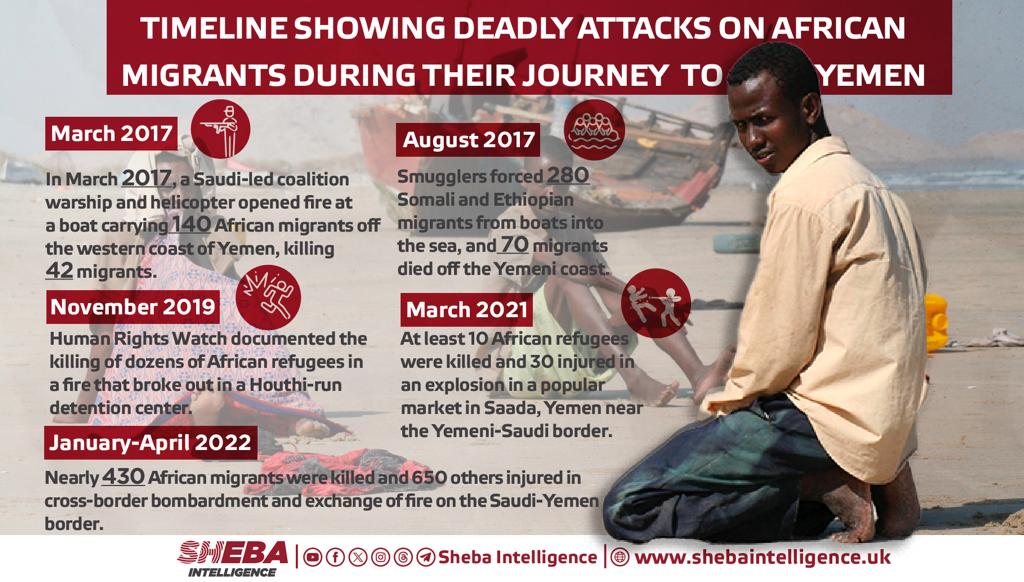
These waves of migrants have been subjected to many violations, violence and killing. Abuses begin at sea, where migrants face the dangers of drowning, pirate attacks, smuggler assaults, and bombing by marine forces and ships. The threats continue until they arrive in the Yemeni cities and to the Yemeni-Saudi border. In March 2017, a Saudi-led coalition warship and helicopter opened fire at a boat carrying 140 African migrants off the western coast of Yemen, killing 42 migrants. In August of the same year, 70 migrants were killed off the Yemeni coast when smugglers forced 280 African refugees from the boats into the sea.
Violations against African refugees by the two warring parties in Yemen continued throughout the war years. Between 2019 and 2020, dozens of migrants were killed in the northern city of Saada and at the Yemeni-Saudi border by the Houthi group and Saudi forces alike. In 2021, a fire incident resulted in dozens of casualties of African refugees at a detention center in the Immigration and Passports Authority in Sana'a. The incident left 44 refugees dead and 180 wounded. According to an Organization for World Peace report, one of the Houthi guards fired tear gas to quell a protest, causing a fire in a refugee hangar housing more than 900 African refugees.
Recruitment: Refugees at the war fronts
Sheba Intelligence interviewed Abdul Rahman Mohammed, a Somali citizen who arrived in Yemen in 2016. Abdul Rahman talked about his journey from Djibouti to Yemen in overcrowded small boats, each of which carries more than 50 refugees, mostly women and young people. He added that upon their arrival to Ras Al-Ara in Lahj province, they were accommodated in crowded hangars and were deprived of food for several days. He further stated that he was insulted and kicked before he was sent to Sana'a. Abdul Rahman added that in Sana'a he cleaned cars for over a year before he decided to move to Saada and from there to Saudi Arabia.
In May 2018, Abdul Rahman was arrested by unknown persons. Later, his detainers offered him a job opportunity, namely, to fight with the Houthis and to work in logistic teams at the Yemeni-Saudi border area in exchange for receiving assistance from the group to enter the city of Saada and from there to proceed to Saudi Arabia, or receiving the amount of 1,000 dollars if he continued in this job and stayed in Sana'a. However, he turned down this offer and was imprisoned, beaten and detained before being transferred by the International Organization for Migration to a refugee camp.
In addition, other testimonies documented the involvement of the Houthi group in exploiting minor African refugees and engaging in mobilizing them as fighters and providers of logistic support, including the transfer of weapons and engagement in intelligence work for the group. The Minister of Information and Culture in the internationally recognized government, Muammar Al-Iryani, tweeted on X that the Houthi group was involved in many violations against African migrants, including compulsory recruitment and using them in transporting ammunition and food supplies, building barricades and digging trenches at the front lines of combat.
The minister's statement was inspired by a recent Human Rights Watch report, which accused Saudi border guards of killing refugees, including children and women, at the Yemeni-Saudi border.
African recruits belie Houthi denial
Videos and images posted on social media pages and YouTube show that migrants from the Horn of Africa participated in combat operations as Houthi fighters. One video shows the interrogation of an African refugee who fought with the Houthis. In this video, the interrogated African migrant admitted that he was exploited and pressured to join Houthi recruits and fighters.
Another video aired by the Houthi-owned Al-Masirah Satellite Channel showed a group of Ethiopian refugees during the funeral of one of the migrants who was killed in battle.
Other videos revealed that the Security Belt in Aden arrested of a group of African refugees who worked in Aden allegedly as an intelligence cell employed by the Houthi group.
Deadly force
A Human Rights Watch report released in August 2023 accused the Saudi border guards of killing migrants with live bullets and projectiles. The same information is leaked by American diplomats, according to the New York Times. The diplomats stated that they received news that those forces used deadly force against African migrants who tried to enter Saudi territory.
Other videos show Saudi border guards deeply involved in operations against African migrants. One of these videos shows the funeral of an African migrant who tried to cross the border into Saudi territory illegally. This incident was preceded by the killing of African refugees in Saudi bombardment of a market in Al Thabet, Talida and Raqqa, Yemeni villages in Saada province near the Yemeni-Saudi border.
However, a Saudi government source denied the accusations then and told AFP that those charges were unfounded and not based on reliable sources.
A local sheikh from one of the border villages told Sheba Intelligence that the killing of African refugees at the border area was due to the Houthi and smugglers' manipulation of African refugees in smuggling operations in border areas.
Although the parties to the Yemeni conflict differ on many issues, they agree in their exploitation and killing of African migrants who fled their countries due to internal conflicts, divisions and poverty. The African migrants only found themselves in a similar situation, or rather, they jumped out of the frying pan into the fire.
African migrants took advantage of the state of lawlessness in Yemen, which allowed them to enter the country easily, but soon discovered the misery they experienced during their journey is worse than the misery in their African countries.